Windy Community
    • Unread
    • Categories
    • Groups
    • Go to windy.com
    • Register
    • Login
    1. Home
    2. pavelneuman
    3. Best
    Offline
    • Profile
    • Following 14
    • Followers 46
    • Topics 200
    • Posts 304
    • Groups 4

    Posts

    Recent Best Controversial
    • Hurricane Dorian coverage
      • Update: At 6:15 p.m. AST (10:15 p.m. UTC), Post-Tropical Dorian has made landfall near Sambro Creek in Nova Scotia, Canada, or about 15 miles (25 km) south of Halifax. The estimated maximum sustained winds at landfall were 100 mph (155 km/h) & the estimated central pressure was 958 mb (28.29 inches). Check out the latest Advisory at nhc.noaa.gov
      • Update: NHC's cones and tracks for Dorian (Adv. 59) and Gabrielle (Adv. 18) have been uploaded to Windy..
      • Update: Dorian becomes a Hurricane-Force Post-Tropical Cyclone. Center is now near the southern coast of Nova Scotia. At 5:00 p.m. AST (9.00 p.m. UTC), the center of Dorian was near 43.9N, 63.9W, moving toward the northeast near 30 mph (48 km/h), and this general motion is expected to continue for the next 24 hours. After that, a turn toward the east-northeast is expected. On the forecast track, the center of Dorian should cross the coast of Nova Scotia near Halifax during the next few hours, then move across eastern Nova Scotia into the Gulf of St. Lawrence near Prince Edward Island tonight. The center should then pass near or over northern Newfoundland and eastern Labrador late tonight or Sunday morning. Maximum sustained winds are near 100 mph (155 km/h) with higher gusts. The post-tropical cyclone is expected to weaken during the next couple of days, and it is forecast to drop below hurricane strength by Sunday morning. Hurricane-force winds extend outward up to 115 miles (185 km) to the south of the center and tropical-storm-force winds extend outward up to 310 miles (500 km). Osbourne Head, Nova Scotia, recently reported sustained winds of 68 mph (109 km/h) and a wind gust of 88 mph (142 km/h). The estimated minimum central pressure is 953 mb (28.15 inches). (Advisory 59, nhc.noaa.gov)
      • Update: We've uploaded the Hurricane Dorian cone/track (Adv. 58) to Windy, including Tropical Storm Gabrielle (Adv. 17).
      • Update: At 2:00 p.m. AST (6:00 p.m. UTC), the center of Hurricane Dorian was located near 42.8N, 64.9 W. Dorian is moving toward the northeast near 29 mph (46 km/h), and a general motion toward the northeast is expected to continue through Sunday night. Recent satellite wind data indicate that the maximum sustained winds are now near 100 mph (155 km/h) with higher gusts. While Dorian is forecast to weaken and become a post-tropical cyclone during the next 24 hours, it is expected to maintain hurricane-force winds as it moves across eastern Canada this afternoon through Sunday. Hurricane-force winds extend outward up to 115 miles (185 km) to the south of the center, and tropical-storm-force winds extend outward up to 310 miles (500 km). NOAA buoy 44011 to the southwest of the center recently reported sustained winds of 74 mph (119 km/h) and a [wind gust](link url) of 94 mph (151 km/h). A station at Baccarro Point, Nova Scotia, recently reported sustained winds of 58 mph (93 km/h). The estimated minimum central pressure is 953 mb (28.15 inches). (Adv. 58, nhc.noaa.gov)
      • Update: We've uploaded the Hurricane Dorian Advisory 55 cone/track to Windy, including Tropical Storm Gabrielle (Adv. 14).
      • Update: The Canadian Hurricane Center has adjusted the warnings for Nova Scotia and New Brunswick and a hurricane warning is now in effect from Lower East Pubnico eastward around Nova Scotia to Avonport, and the tropical storm warning is effect from Tidnish to Brule and from Fundy National Park to Shediac. At 11:00 p.m. EDT (3:00 a.m. UTC), the center of Hurricane Dorian was located near 38.3N, 70.2W, moving toward the northeast near 25 mph (41 km/h). Max. sustained winds remain near 90 mph (150 km/h), the estimated minimum central pressure is 960 mb (28.35 inches). (Advisory 55, nhc.noaa.gov)
      • Update: We've uploaded the latest cone/track forecast from NHC's Intermediate Advisory #54A to Windy. Click here to view it on any Windy forecast (or satellite/radar) layer. The text of the latest public advisory is available at nhc.noaa.gov
      • Update: At 5:00 p.m. EDT (9:00 p.m. UTC), Category 1 Hurricane Dorian was near 36.9N, 72.7W, moving toward the northeast near 24 mph (39 km/h). Maximum sustained winds are near 90 mph (150 km/h). Dorian should move move to the southeast of extreme southeastern New England tonight and Saturday morning, and then across Nova Scotia late Saturday or Saturday night. Some strengthening is possible during the next 24 hours. Dorian is forecast to become a post-tropical cyclone with hurricane-force winds Saturday night or Sunday while it is near or over eastern Canada. photo:NOAA/NHC;desc:Hurricane Dorian Key Messages (Adv. 54) Tropical storm conditions will persist for a few more hours in the warning area over the Mid-Atlantic states. Tropical storm conditions are expected in the warning area over portions of extreme southeastern Massachusetts tonight or early Saturday, and in the warning area in Maine Saturday afternoon. Regardless of whether Dorian is a hurricane or a post-tropical cyclone, hurricane conditions are expected in the Hurricane Warning area Saturday or Saturday night, and they are possible in the Hurricane Watch area Saturday or Saturday night. Tropical storm conditions are expected in the Tropical Storm Warning area in Canada by Saturday, and they are possible in the Tropical Storm Watch area Saturday and Saturday night. The Canadian Hurricane Center has issued a Tropical Storm Watch for Newfoundland from Boat Harbour to Triton. All Hurricane and Tropical Storm Warnings are discontinued south of the North Carolina/Virginia Border. The Tropical Storm Warning is discontinued for the Tidal Potomac south of Cobb Island. The Storm Surge Warning has been discontinued north of the North Carolina/Virginia border. (Advisory 54, nhc.noaa.gov)
      • Update: We've uploade the latest cone & track forecasts for Hurricane Dorian (Adv. 53) and Tropical Storm Gabrielle (Adv. 12)
      • Update: At 11:00 a.m. EDT (3:00 p.m. UTC), the center of Hurricane Dorian was near 35.7N, 74.8W.
        Hurricane conditions should end along portions of the North Carolina coast during the next few hours. Tropical storm conditions should continue on the southeastern coast of Virginia for the next several hours, and are expected to spread across other portions of the the Mid-Atlantic states later today. Tropical storm conditions are also expected in the warning area over portions of extreme southeastern Massachusetts tonight or early Saturday, and in the warning area in Maine Saturday afternoon (Advisory 53, nhc.noaa.gov)
      • Update: We've uploaded the latest NHC's cone and track forecast for Hurricane Dorian (Adv. 51)
      • Update: We've uploaded the latest NHC's cone and track forecast for Hurricane Dorian (Adv. 50) and TS Gabrielle (Adv. 9)
      • Update: At 5:00 p.m. EDT (9:00 p.m. UTC), the eye of [Hurricane Dorian](link url) was near 33.1N, 78.5W, max. sustained winds are now near 105 mph (165 km/h). The Tropical Storm Watch from Woods Hole to Sagamore Beach, Massachusetts, and for Martha's Vineyard and Nantucket has been changed to a Tropical Storm Warning. The Hurricane Warning from Savannah River to south of Edisto Beach, South Carolina has been changed to a Tropical Storm Warning. The Storm Surge Warning has been discontinued south of Little River Inlet. photo:NOAA/NHC;desc:Hurricane Dorian Key Messages (Adv. 50) Summary of warnings in effect: A Storm Surge Warning is in effect for Little River Inlet to Poquoson VA, Pamlico and Albemarle Sounds, Neuse and Pamlico Rivers, and Hampton Roads. A Hurricane Warning is in effect for Edisto Beach SC to the North Carolina/Virginia border, and Pamlico and Albemarle Sounds. A Tropical Storm Warning is in effect for Savannah River to south of Edisto Beach SC, North Carolina/Virginia border to Fenwick Island DE, Chesapeake Bay from Drum Point southward, Tidal Potomac south of Cobb Island, Woods Hole to Sagamore Beach MA, and Nantucket and Martha's Vineyard MA (Advisory 50, nhc.noaa.gov)
      • Update: We've uploaded the latest NHC's cones and track forecasts to Windy (Adv. 49)
      • Update: At 11:00 a.m. EDT (3:00 p.m. UTC), the center of Hurricane Dorian was near 32.5N, 79.1W. Reports from Air Force Reserve and NOAA Hurricane Hunter aircraft indicate that
        The Tropical Storm Warning has been extended northward to Fenwick Island, Delaware, and also extended northward in the Chesapeake Bay to Drum Point, including the Tidal Potomac River south of Cobb Island. The Storm Surge Warning has been discontinued south of Edisto Beach, South Carolina. (Advisory 49, nhc.noaa.gov)
      • Update: We've uploaded the latest cone and track forecast for Hurricane Dorian (Adv. 48A) and Tropical Storm Gabrielle (Adv. 7).
      • Update: Update At 8:00 a.m. EDT (12:00 p.m. UTC), the eye of Hurricane Dorian, strengthened to category 3 hurricane, was near 32.1N, 79.3W, with max. sustained winds near 115 mph (185 km/h). Dorian is now moving toward the north-northeast near 8 mph (13 km/h). A turn toward the northeast is anticipated by tonight, and a northeastward motion at a faster forward speed is forecast on Friday. On the forecast track, the center of Dorian will continue to move close to the coast of South Carolina today, and then move near or over the coast of North Carolina tonight and Friday. The center should move to the southeast of extreme southeastern New England Friday night and Saturday morning, and approach Nova Scotia later on Saturday. (Advisory 48A, nhc.noaa.gov)
      • Update: Tropical storm conditions occuring along portions of the South Carolina coast. A Weatherflow station at Winyah Bay, South Carolina recently reported sustained winds of 45 mph (72 km/h) and a wind gust of 58 mph (93 km/h). (Hurricane Dorian Tropical Cyclone Update 7:00 a.m. EDT / 11:00 a.m. UTC, NHC Miami Florida)
      • Update: At 8:00 p.m. EDT (12:00 a.m. UTC), the large eye of Hurricane Dorian was located near 30.9N, 79.8W, max. sustained winds remain near 110 mph (175 km/h) with higher gusts. The minimum central pressure reported by the Hurricane Hunter is 959 mb (28.31 inches). (Advisory 46A, nhc.noaa.gov)
      • Update: We've uploaded cone and track forecast for Hurricane Dorian (Adv #46), Tropical Storm Gabrielle (Adv. #7), Tropical Depression Fernand (Adv. #7), Hurricane Juliette (Adv. #17), Post-Tropical Cyclone Gil (Adv. #7)
      • Update: At 8:00 a.m. EDT (12:00 p.m. UTC), the eye of Hurricane Dorian, strengthened to category 3 hurricane, was near 32.1N, 79.3W, with max. sustained winds near 115 mph (185 km/h). Dorian is now moving toward the north-northeast near 8 mph (13 km/h). A turn toward the northeast is anticipated by tonight, and a northeastward motion at a faster forward speed is forecast on Friday. On the forecast track, the center of Dorian will continue to move close to the coast of South Carolina today, and then move near or over the coast of North Carolina tonight and Friday. The center should move to the southeast of extreme southeastern New England Friday night and Saturday morning, and approach Nova Scotia later on Saturday. (Advisory 48A, nhc.noaa.gov)
      • Update: Tropical storm conditions occuring along portions of the South Carolina coast. A Weatherflow station at Winyah Bay, South Carolina recently reported sustained winds of 45 mph (72 km/h) and a wind gust of 58 mph (93 km/h). (Hurricane Dorian Tropical Cyclone Update 7:00 a.m. EDT (11:00 a.m. UTC), NHC Miami Florida)
      • Update: At 8:00 p.m. EDT (12:00 a.m. UTC), the large eye of Hurricane Dorian was located near 30.9N, 79.8W, max. sustained winds remain near 110 mph (175 km/h) with higher gusts. The minimum central pressure reported by the Hurricane Hunter is 959 mb (28.31 inches). (Advisory 46A, nhc.noaa.gov)
      • Update: We've uploaded cone and track forecast for Hurricane Dorian (Adv #46), Tropical Storm Gabrielle (Adv. #5), Tropical Depression Fernand (Adv. #7)
      • Update: At 5:00 p.m. EDT (9:00 p.m. UTC), the center of Hurricane Dorian was located near 30.6N, 79.8W, with max. sustained winds increased to near 110 mph (175 km/h), moving toward the north-northwest near 8 mph (13 km/h). A turn to the north is expected tonight, followed by a turn to the north-northeast on Thursday and a turn toward the northeast on Thursday night. A northeastward motion at a faster forward speed is forecast on Friday. On the forecast track, the center of Dorian will approach the coast of South Carolina tonight, move near or over the coast of South Carolina on Thursday, and move near or over the coast of North Carolina Thursday night and Friday. photo:NOAA/NHC;desc:Hurricane Dorian Key Messages (Advisory 46)The Storm Surge Warning has been extended northward to Poquoson, Virginia, including Hampton Roads. A Tropical Storm Warning has been issued from the North Carolina/Virginia border to Chincoteague, Virginia, and for the Chesapeake Bay from Smith Point southward. A Tropical Storm Watch has been issued from north of Chincoteague, Virginia, to Fenwick Island, Delaware, for the Chesapeake Bay from Smith Point to Drum Point, and for the Tidal Potomac River south of Cobb Island. The Storm Surge Warning and Tropical Storm Warning have been discontinued south of the Flagler/Volusia County line. (Advisory 46, nhc.noaa.gov)
      • Update: We've uploaded (NHC's Adv. #44 cone and track forecast, now Including Tropical Storm Fernand and Tropical Storm Gabrielle
      • Update At 5:00 a.m. EDT (9:00 a.m. UTC), the center of Hurricane Dorian was located near 29.2N, 79.5 W. Maximum sustained winds are near 105 mph (165 km/h). The minimum central pressure reported by an Air Force Reserve Unit Hurricane Hunter aircraft is 963 mb (28.44 inches). The government of the Bahamas has discontinued all Tropical Storm Warnings for the Bahamas. The Tropical Storm Warning south of Sebastian Inlet, FL has been discontinued. The Hurricane Warning from Sebastian Inlet FL to the Volusia/Brevard County FL line is changed to a Tropical Storm Warning.
      • Update We've uploaded (NHC's Adv. #42 cone and track forecast
      • Update At 5:00 p.m. EDT (9:00 p.m. UTC), the center of Hurricane Dorian was located near 27.7N, 78.7W, with
      • Update At 11:00 a.m. EDT (3:00 p.m. UTC). Dorian, weakened to category 3 hurricane, was near 27.1N, 78.6W, max. sustained winds near 110 mph (175 km/h), min. central pressure 955 mb (28.20 inches). Check out the latest cone and track forecast.

        The Storm Surge Warning has been extended northward to South Santee River, South Carolina. The Storm Surge Watch has been extended northward to Cape Lookout, North Carolina. A Hurricane Warning has been issued for the coast of South Carolina from north of Edisto Beach to the South Santee River. A Hurricane Watch has been issued from north of South Santee River to Duck, North Carolina, including the Pamlico and Albemarle Sounds. The Tropical Storm Warning has been extended north to Edisto Beach, South Carolina. The Storm Surge Warning has been discontinued south of Jupiter Inlet, Florida. The Storm Surge Watch has been discontinued south of Lantana, Florida has been discontinued. The Hurricane Watch from Deerfield Beach to Jupiter Inlet has been discontinued. The Tropical Storm Watch from Golden Beach to Deerfield Beach has been discontinued. (Adv. 41 by NWS National Hurricane Center Miami FL - nhc.noaa.gov)
      • Update At 11:00 p.m. EDT (3:00 a.m. UTC), the eye of Hurricane Dorian was located near 26.9N, 78.5W. Maximum sustained winds are near 130 mph (215 km/h) with higher gusts. The estimated minimum central pressure based on data from the Air Force and NOAA Hurricane Hunters was 946 mb (27.94 inches). View the latest cone and track on any Windy layer.
      • Update At 8:00 p.m. EDT (12:00 a.m. UTC), the eye of Hurricane Dorian was near 26.8N, 78.4W. Category 4 Hurricane Dorian remains nearly stationary just north of Grand Bahama Island - Intermediate Advisory Number 38A (nhc.noaa.gov) photo:NOAA/NHC;desc:Intermediate Advisory Number 38A; Click to check out the Advisory Number 38A cone & track on any Windy layer
      • Update We've uploaded the NHC's cone & track from Advisory #38 to Windy.
      • Update The eye of dangerous hi-end category 4 Hurricane Dorian around 10 p.m. UTC photo:Windy.com;desc:The eye of Dorian - 2 September 2019 around 10 p.m. UTC;licence:cc
      • Update Devastating conditions caused by Category 4 Hurricane Dorian continue on Grand Bahama Island. At 5:00 p.m. EDT (9:00 p.m. UTC), the eye of Hurricane Dorian was located near 26.8N, 78.4W. Dorian has become nearly stationary this afternoon. A slow westward to west-northwestward motion is expected to resume overnight and continue into early Tuesday. A turn toward the northwest is forecast by late Tuesday, with a northeastward motion forecast to begin by Wednesday night. On this track, the core of extremely dangerous Hurricane Dorian will continue to pound Grand Bahama Island into Tuesday morning.

        Dorian will then move dangerously close to the Florida east coast late Tuesday through Wednesday evening and then move dangerously close to the Georgia and South Carolina coasts on Wednesday night and Thursday.

        An Air Force Reserve Hurricane Hunter aircraft has found that max. sustained winds are near 145 mph (230 km/h) with higher gusts.

        Sustained winds of 55 mph (89 km/h) with a gust to 69 mph (111 km/h) was recently reported at a NOAA Coastal Marine observing site at Settlement Point on the west end of Grand Bahama Island. A wind gust of 43 mph (69 km/h) was reported at Opa Locka Airport near Miami earlier this afternoon. The latest minimum central pressure reported by an Air Force Reserve Hurricane Hunter aircraft is 940 mb (27.76 inches).

        A Storm Surge Warning is in effect for Lantana to Altamaha Sound. A Storm Surge Watch is in effect for North of Deerfield Beach to south of Lantana and Altamaha Sound to South Santee River. A Hurricane Warning is in effect for Grand Bahama and the Abacos Islands in the northwestern Bahamas and Jupiter Inlet to Ponte Vedra Beach. A Hurricane Watch is in effect for North of Deerfield Beach to Jupiter Inlet and North of Ponte Vedra Beach to South Santee River. A Tropical Storm Warning is in effect for North of Deerfield Beach to Jupiter Inlet. A Tropical Storm Watch is in effect for North of Golden Beach to Deerfield Beach and Lake Okeechobee (Adv. 38 by NWS National Hurricane Center Miami FL - nhc.noaa.gov)
      • Update At 11:30 a.m. UTC, Hurricane Dorian was approx. at 26.48N, 78.17W. With max. sustained winds of 155 mph, Dorian weakened to hi-end Category 4 Hurricane.
      • Update Category 5 Dorian continues to have devastating impacts on Grand Bahama Island. Uploaded the latest cone & track forecast from the NHC's Advisory 36. Check it out on any Windy forecast layer. Current Summary: Location: 26.6N 78.2W (about 40 miles (60 km) E of Freeport Grand Bahama island, 115 miles (190 km) E of West Palm Beach Florida), max sustained winds: 165 mph (270 km/h), min. central pressure: 916 Mb (27.05 inches)
      • Update Uploaded the latest cone & track forecast from the NHC's Advisory 35. Check it out on any Windy forecast layer.
      • Update Catastrophic Category 5 Dorian makes landfall on the eastern end of Grand Bahama island. Maximum sustained winds are near 180 mph (285 km/h). A Storm Surge Warning is in effect for Lantana to the Volusia/Brevard County Line. A Storm Surge Watch is in effect for North of Deerfield Beach to Lantana and Volusia/Brevard County Line to the Mouth of the St. Mary's River. A Hurricane Warning is in effect for Northwestern Bahamas excluding Andros Island and Jupiter Inlet to the Volusia/Brevard County Line. A Hurricane Watch is in effect for Andros Island, North of Deerfield Beach to Jupiter Inlet and Volusia/Brevard County Line to the Mouth of the St. Mary's River. A Tropical Storm Warning is in effect for North of Deerfield Beach to Jupiter Inlet. A Tropical Storm Watch is in effect for North of Golden Beach to Deerfield Beach and Lake Okeechobee (Advisory #35, 11:00 p.m. EDT/ 3:00 a.m. UTC by nhc.noaa.gov)
      • Update Catastrophic Category 5 Hurricane Dorian is pounding Great Abaco and Grand Bamaha. Hurricane conditions are expected in Florida by late Monday/Tuesday. At 8:00 p.m. EDT (0:00 UTC), the distinct eye of Hurricane Dorian was located near 26.6N, 77.6W, moving toward the west near 5 mph (7 km/h). Maximum sustained winds remain near 185 mph (295 km/h) - NHC's Advisory 34A
      • Update Added the latest NHC's cone & track (Adv. #34).
      • Update The distinct eye of powerful Hurricane Dorian is moving over Great Abaco. The latest wind and pressure data from an Air Force reconnaissance plane just before the eye hit the island indicated that the winds reached exceptional 160 kt. The minimum pressure measured by the plane was 910 mb. The eye has been shrinking, and an eyewall replacement cycle is possibly occurring. The effect of the island terrain and the eyewall replacement cycle should result in some slight fluctuations in intensity during the next 24 to 36 hours, but the hurricane will continue to be extremely dangerous one during that time. After 3 days, a more definite weakening trend should begin. Dorian however, it is forecast to remain a hurricane for the next 5 days. Dorian is expected to slow down a little more, prolonging its catastrophic effects in the northwestern Bahamas. The NHC forecast calls for a slow west to west-northwest motion during the next 48 hours. Both the deterministic and consensus tracks have shown the usual variability to the right or to the left from run to run, but the overall trend is for the hurricane to turn northward offshore but dangerously close to the Florida peninsula. Given the uncertainty in the track forecast and the anticipated increase in size of the hurricane, a Hurricane Warning and Storm Surge Warning have been issued for a portion of the Florida east coast. It is once again emphasized that although the official track forecast does not show landfall, users should not focus on the exact track. A small deviation to the left of the track could bring the intense core of the hurricane its dangerous winds closer to or onto the Florida coast. photo:NWS National Hurricane Center Miami FL;desc:Advisory 34; (Advisory #34 by NWS National Hurricane Center Miami FL)
      • Update The extremely distinct eye of catastrophic Hurricane Dorian is now over Abacos Islands in The Bahamas heading with all its fury toward Grand Bamaha. At 2:00 p.m. EDT (6:00 p.m. UTC), the eye of Hurricane Dorian was located near 26.5N, 77.1W. Maximum sustained winds are near 185 mph (295 km/h) with higher gusts.(Hurricane Dorian Intermediate Advisory 33A)
      • Update Uploaded the latest cone & track forecast from the NHC's Advisory 33. Check it out on any Windy weather/climate layer.
      • Update At 11:00 a.m. EDT (3:00 p.m. UTC) Dorian was located near 26.5N, 76.8W, about 205 miles (330 km) E of W Palm Beach, Florida, max. sustained winds 180 mph (285 km/h). A Storm Surge Watch is in effect for North of Deerfield Beach to the Volusia/Brevard County Line. A Hurricane Warning is in effect for Northwestern Bahamas excluding Andros Island. A Hurricane Watch is in effect for Andros Island and North of Deerfield Beach to the Volusia/Brevard County Line. A Tropical Storm Warning is in effect for North of Deerfield Beach to Sebastian Inlet. A Tropical Storm Watch is in effect for North of Golden Beach to Deerfield Beach and Lake Okeechobee.
      • Update Dorian Tropical Cyclone Update 9:30 a.m. EDT (1:30 p.m. UTC) - Cat 5 Hurricane Dorian now has maximum sustained winds near 175 mph (280 km/h), with a minimum central pressure of 922 mb (27.23 inches). The eyewall of catastrophic Hurricane Dorian is currently reaching the Abaco Islands. This is a life-threatening situation. Residents there should take immediate shelter. Do not venture into the eye if it passes over your location. Hazards: Wind Gusts over 200 mph; Storm Surge 15 to 20 feet above normal tide levels with higher destructive waves. These hazards will cause extreme destruction in the affected areas and will continue for several hours.
      • Update We've uploaded the NHC's Hurricane-Force Wind Probablilities forecast KMZ file to Windy. Also check out the Adv. 32A cone & track. (see the NHC's original graphics below)
      • Update Dorian is now a category 5 hurricane. Data from an Air Force Hurricane Hunter plane indicate that the maximum sustained winds have increased to near 160 mph (260 km/h) with higher gusts. At 8:00 a.m. EDT (12:00 p.m. UTC), the distinct eye of Hurricane Dorian was located near 26.5N, 76.5W, moving toward the west near 8 mph (13 km/h). On its track, the core of extremely dangerous Hurricane Dorian should be moving over Great Abaco soon, and continue near or over Grand Bahama Island later tonight and Monday. The hurricane should move closer to the Florida east coast late Monday through Tuesday night. photo:NOAA/NHC;desc:Key Messages for Hurricane Dorian Check out the NHC's latest cone & track forecast (Adv. 32A) over any Windy layer. photo:NOAA/NHC;desc:Dorian Hurricane-Force Wind Speed Probabilities Check out the NHC's Dorian Hurricane-Force Wind Speed Probabilities forecast (Adv. 32A)** over any Windy layer
      • Update 31 August 2019 - Severe hurricane Dorian, maintaining its hi-end category 4 hurricane status, is forecast to hit portions of the northwestern Bahamas hard on Sunday. A Hurricane Warning is in effect for Northwestern Bahamas excluding Andros Island. A Hurricane Watch is in effect for Andros Island. A Tropical Storm Watch is in effect for Deerfield Beach to Sebastian Inlet. At 5:00 p.m. EDT (9:00 p.m. UTC), Dorian was near 26.2N, 74.4W, moving toward the west near 8 mph (13 km/h). A slower westward motion should continue for the next day or two, followed by a gradual turn toward the northwest. Maximum sustained winds remain near 150 mph (240 km/h) with higher gusts. Hurricane-force winds extend outward up to 30 miles (45 km) from the center and tropical-storm-force winds extend outward up to 105 miles (165 km). The estimated minimum central pressure is 945 mb (27.91 inches). photo:NWS National Hurricane Center;desc:Hurricane Dorian Advisory 30 (click to view the Adv. #30 cone on any Windy layer)
      • Update At 2:00 p.m. EDT (6:00 p.m. UTC), the distinct eye of Hurricane Dorian was located near latitude 26.1 North, longitude 73.9 West. Dorian is moving toward the west near 8 mph (13 km/h), and a slower westward motion should continue into early next week. On this track, the core of Dorian should move over the Atlantic well north of the southeastern and central Bahamas today, be near or over the northwestern Bahamas on Sunday, and move near the Florida east coast late Monday through Tuesday. Maximum sustained winds are near 150 mph (240 km/h)
      • Update Check out the Hurricane Dorian Advisory #29 cone and track by the NHC over any Windy layer here.
      • Update At 3:00 p.m. UTC, Category 4 hurricane Dorian was located near 26.0N, 73.24W. Data from both NOAA and Air Force Hurricane Hunter planes indicate that the maximum sustained winds have increased to near 150 mph (240 km/h) with higher gusts. Some fluctuations in intensity are likely, but Dorian is expected to remain a powerful hurricane during the next few days. A Hurricane Warning is in effect for Northwestern Bahamas excluding Andros Island. A Hurricane Watch is in effect for Andros Island.
      • Update Dorian strengthened to major category 4 hurricane, with max. sustained winds near 140 mph (220 km/h). Some strengthening is possible today. Although fluctuations in intensity are possible early next week, Dorian is expected to remain a powerful hurricane during the next few days. At 2:00 a.m. EDT (6:00 a.m. UTC), the center of Hurricane Dorian was located near 25.6N, 72.0W. On its track, the core of Dorian should move over the Atlantic well north of the southeastern and central Bahamas today, be near or over the northwestern Bahamas on Sunday, and be near the Florida east coast late Monday. (Hurricane Dorian Intermediate Advisory Number 27A)
      • Update Check out the NHC's Earliest-Reasonable Time of Arrival (Adv. #26) on any Windy layer photo:Windy.com;desc:Earliest-Reasonable Time of Arrival (Adv. #26 by The NHC;licence:cc;)
      • Update Article was updated with Copernicus Sentinel3’s imagery (see below)
      • Update Extremely dangerous hurricane Dorian, stenghtened to Category 3, is heading to northwestern Bahamas. A Hurricane Warning is in effect for northwestern Bahamas excluding Andros Island, a Hurricane Watch is in effect for Andros Island. At 5:00 p.m. EDT (9:00 p.m. UTC), the well-defined eye of Hurricane Dorian was located near 25.0N, 70.7W. On this track, the core of Dorian should move over the Atlantic well north of the southeastern and central Bahamas tonight and tomorrow, be near or over the northwestern Bahamas on Sunday, and be near the Florida east coast late Monday. Maximum sustained winds were near 115 mph (185 km/h) with higher gusts (Hurricane Dorian Advisory #26 by NWS National Hurricane Center Miami FL).
      • Update Click to view the 64kt wind speed probabilities forecast (Advisory #25) over the last 12 hrs satellite loop (or any Windy forecast layer)
      • Update At 11:00 a.m. AST (3:00 a.m. UTC), the eye of Hurricane Dorian was located near 24.5N, 69.8W. A slower west-northwestward to westward motion should begin tonight and continue into early next week. Dorian should move over the Atlantic well north of the southeastern and central Bahamas today and tomorrow, be near or over the northwestern Bahamas on Sunday, and be near the Florida peninsula late Monday. A Hurricane Watch is in effect for Northwestern Bahamas.
      • Update Hurricane Hunters find Dorian a little stronger. Check out the NHC's hurricane Dorian Intermediate Advisory 24A cone and track (click here).
      • Update: At 5:00 p.m. AST (9:00 p.m. UTC), the center of Hurricane Dorian was located near 22.5N, 67.7W, with maximum sustained winds near 85 mph (140 km/h). Check out the latest cone and track by NHC (Public Adv. 22)
      • Update: Hurricane Dorian continues to gain intensity. The National Hurricane Center forecasts it will become a major hurricane (Category 3 or 4) by Friday. At 11:00 a.m. AST (3:00 p.m. UTC), the center of Hurricane Dorian was located near 21.4N, 67.2W, with maximum sustained winds near 85 mph (140 km/h). A west-northwestward motion is forecast to begin by Friday night and continue into the weekend. On this track, Dorian should move over the Atlantic well east of the southeastern and central Bahamas today and on Friday, approach the northwestern Bahamas Saturday, and move near or over portions of the northwest Bahamas on Sunday. Dorian is expected to become a major hurricane on Friday, and remain an extremely dangerous hurricane through the weekend.
      • Update: On August 28th 11:00 p.m. AST (3:00 a.m. UTC), the center of Hurricane Dorian was located near 19.7N, 66.0W. Dorian is moving toward the northwest near 13 mph (20 km/h), and this general motion is expected to continue through Friday. Click here to get the latest NHC's cone & track (Adv. 19) displayed on any Windy forecast layer.
      • Update: Check out the earliest reasonable arrival time of tropical storm force winds from Adv.18 by NOAA/NHC over last 12 hours satellite loop (you can switch to any forecast layer too). Click here. photo:Windy.com;desc:The Earliest Reasonable Arrival Time of Tropical Storm Force Winds by NOAA/NHC
      • Update: At 5:00 p.m. AST (9:00 p.m. UTC), the apparent eye of Hurricane Dorian was located near 18.8N, 65.5W. Dorian is moving toward the northwest near 14 mph (22 km/h). On this track, Dorian should continue to move near or over the U.S. and British Virgin Islands during the next several hours and then move over the Atlantic well east of the southeastern Bahamas on Thursday and Friday. Maximum sustained winds have increased to near 80 mph (130 km/h) with higher gusts. Dorian is forecast to strengthen and become a powerful hurricane during the next few days over the Atlantic waters.
      • Update: Dorian strengthened to Category 1 hurricane earlier this afternoon

      31 August 2019

      30 August 2019
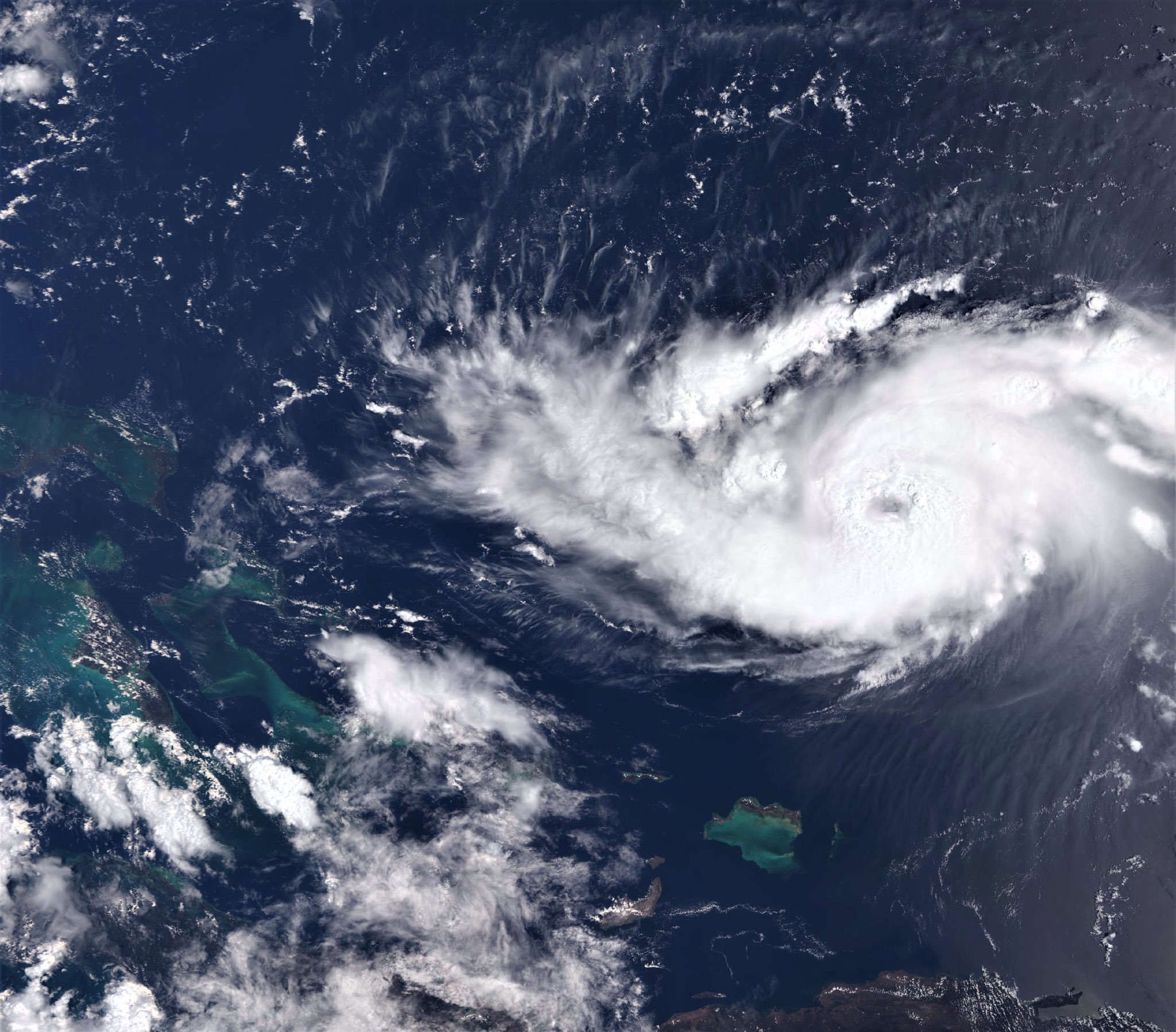
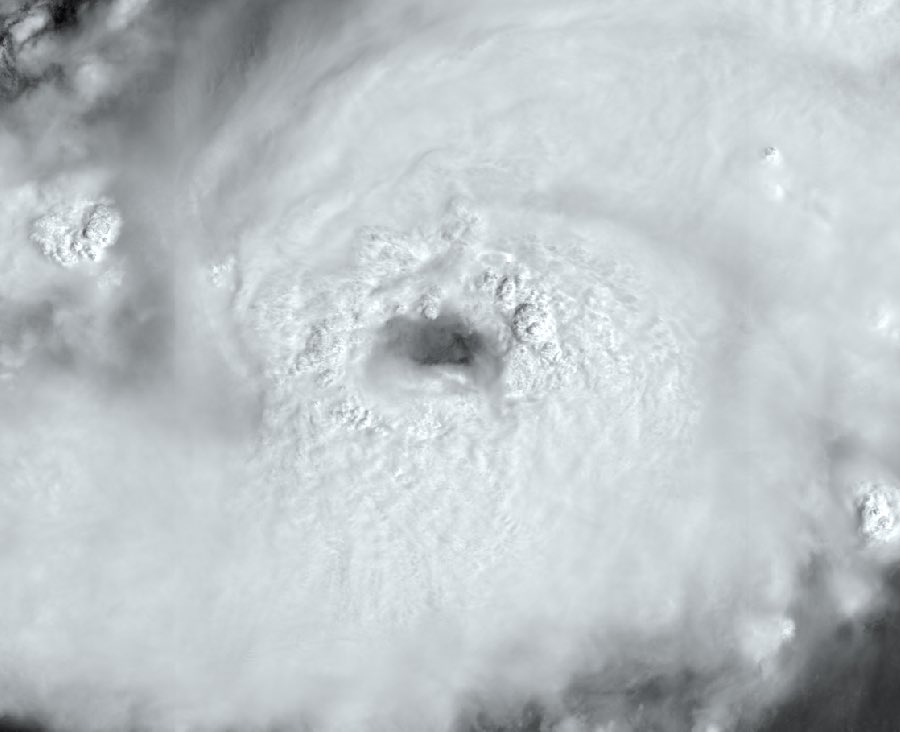
      photo:Copernicus EMS;desc:The Eye of Hurricane Dorian,  Sentinel3’s OLCI instrument in true colours (wide view) 30 Aug 2019 at 14:53:41 UTC

      photo:Copernicus EMS;desc:The Eye of Hurricane Dorian,  Sentinel3’s OLCI instrument in true colours (zoom) 30 Aug 2019 at 14:53:41 UTC

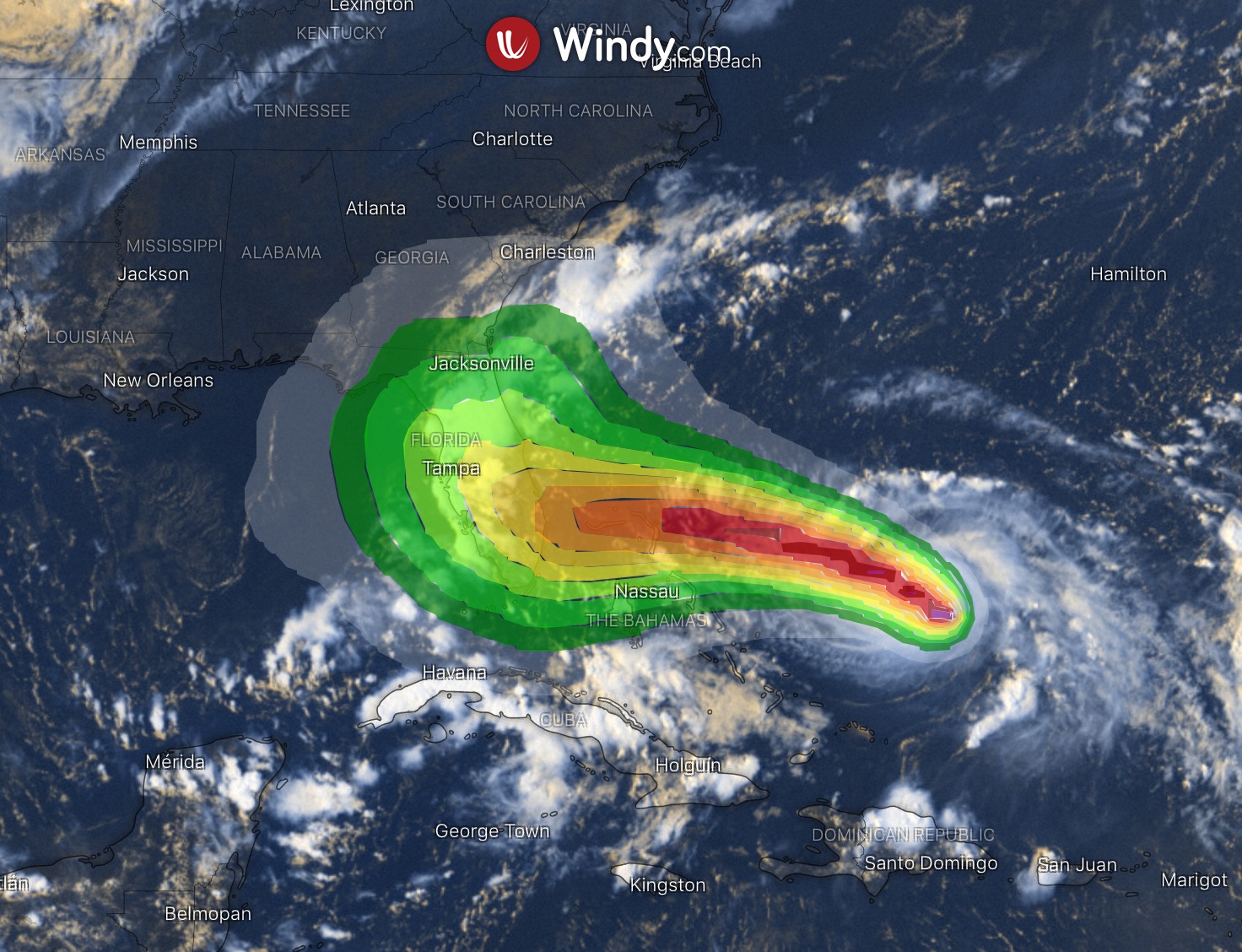
      photo:WIndy.com;desc:64kt wind speed probabilities forecast (NOAA/NHC) over the last 12 hours max. winds forecast (ECMWF

      • Click here to view the 64kt wind speed probabilities forecast (Advisory #25) over the last 12 hrs satellite loop (or any Windy forecast layer)

      29 August 2019

      We just released the first special weather balloon in support of #HurricaneDorian. Our office is one of 18 across the Southern US doing these special, 6-hourly, releases. Data acquired from these flights will help improve the forecast for #Dorian. —NWS Brownsville

      28 August 2019

      Full day 1 min res. GOES-16 loop
      • Track the path of Hurricane Dorian with Windy Hurricane Tracker

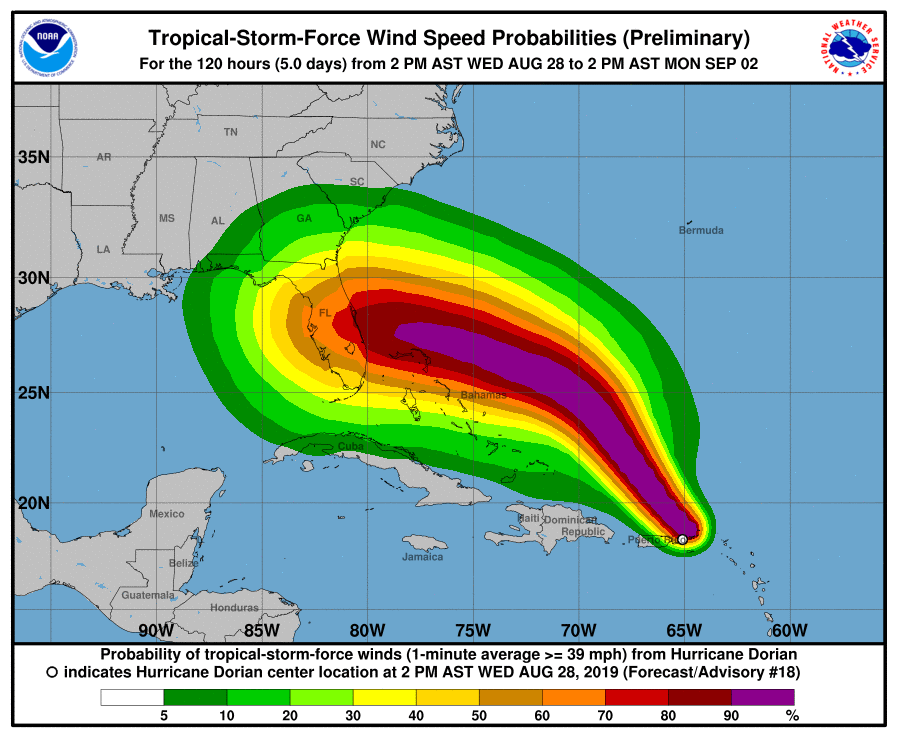
      photo:NOAA/NHC; TS Dorian Wind Speed Probabilities

      Tropical Storm Dorian is forecast to develop into a Category 2 hurricane after making landfall in Puerto Rico.

      • Track the path of Dorian with Windy Hurricane Tracker

      The National Hurricane Center (NHC) expects the tropical storm conditions in Puerto Rico, with the possibility of hurricane conditions, but over the weekend the storm may strengthen to a Category 2 hurricane as it moves toward the east coast of Florida.

      After hitting Puerto Rico, which is still recovering from Hurricane Maria in 2017, Dorian is forecast to strengthen into a Category 1 hurricane by Friday morning.

      Dorian si forecast to strengthen again throgh Sunday morning, before arriving at Florida's coast and making landfall as a Category 2 hurricane late Sunday or Monday along the east coast of Florida.

      The NHC has issued hurricane watch and tropical storm warnings for Puerto Rico and the Dominican Republic.

      A Hurricane Warning

      • Vieques and Culebra
      • U.S. Virgin Islands
      • British Virgin Islands

      A Hurricane Watch and a Tropical Storm Warning

      • Puerto Rico

      A Tropical Storm Watch

      • Dominican Republic from Isla Saona to Samana

      photo:NHC;desc:11 AM AST/EDT August 28 Key Messages for Tropical Storm Dorian

      The governor of Puerto Rico has declared a state of emergency for US territory on Monday.

      Based on the current track of Tropical Storm Dorian, all residents on the East Coast should prepare for impacts, including strong winds, heavy rain and flooding. Make sure to have your supplies ready and follow @FLSERT (Florida Division of Emergency Management) and local media for the latest updates on the forecast. —Ron DeSantis, governor of Puerto Rico

      Yesterday, the US president has approved an emergency declaration.

      photo:Office of the Press Secretary;desc:US president has approved an emergency declaration

      • Track the path of Dorian with Windy Hurricane Tracker: http://bit.ly/dorian_tracker

      https://www.windy.com/upload/5d7424970ba7fc001941fe63?satellite,29.037,-80.859,4,internal

      posted in Articles article hurricaneseason hurricane tropicalstorm florida
      pavelneumanP
      pavelneuman
    • What is a CAPE index?

      CAPE in meteorology

      If you’re wondering what the Windy’s CAPE index forecast layer is good for, a meteorology and medicine nerd Luke gives you an answer in a thread on Twitter.

      Convective Available Potential Energy is a measure of the energy that can be created if there is enough heat in a cloud to give convection.

      The values are given in Joules per Kilogram of air as a general rule.

      The greater the energy that is released during convection, the greater will be the charge separation and the more lightning is liable to occur.

      CAPE index of lightning risk

      • < 1000 -Slight
      • 1000 - 2500 - Moderate
      • 2500 - 3500 - Very
      • > 3500 - Extremely

      CAPE is usually used by people at sea. Sailing without checking CAPE can be dangerous. It's a great way of predicting how much lightning an area will get and Windy have a fantastic CAPE setting so check it out.

      (Thanks to MailASail for some info)

      Please keep in mind that CAPE index, as a measure of instability, is only one of the factors to consider when you forecast the thunderstorms. @Gkikas-LGPZ sums it up nicely.

      However, instablility on it's own is not enough to ensure thunderstorms. There needs to be a lifting factor due to orography or frontal activity. Check for other hints such as high humidity and a forecast of showers in the area.

      Example: the following images show forecast for same time (25 July 2019 / 00 UTC). Although high CAPE values in the Balearic islands (West Mediterranean Sea), no thunderstorms expected.
      CAPE and thunderstorms

      CAPE definition

      In meteorology, convective available potential energy (CAPE), sometimes, simply, available potential energy (APE), represents potential energy of atmosphere and can be indicator of forming convective clouds and storms.

      CAPE is effectively the positive buoyancy of an air parcel (mass of air) and is an indicator of atmospheric instability, which makes it very valuable in predicting severe weather.

      Values from 1000 to 2000 can indicate forming of moderate thunderstorms, and over 2000 severe ones.

      CAPE for a given region is most often calculated from a thermodynamic or sounding diagram (known as a Skew-T log-P diagram) using air temperature and dew point data usually measured by a weather balloon.

      Show the Sounding diagram

      Sounding diagram is also available on Windy, just right click the place and choose Sounding forecast from the contextual menu.

      Sounding diagram

      If you prefer Skew-T style sounding diagram, there’s an amazing plugin by John Kealy (project on Github).

      Skew-T diagram

      posted in Articles article cape thunderstorms lightnings sounding
      pavelneumanP
      pavelneuman
    • Leonardo DiCaprio shares a map showing the impact of the Amazon wildfires

      photo: @leonardodicaprio on Instagram;

      OK, here we go. Our first ever 100% bragging post here on Windy. It doesn't happen every day that you stumble upon an Instagram post by Leonardo DiCaprio featuring Windy.com.

      The famous Hollywood actor posted our CO concentration map, depicting the impact of ongoing Amazon wildfires.

      photo: @leonardodicaprio on Instagram;

      The fact it’s just a regram of the @rainforestalliance' post doesn’t make us any less excited. Right now, his post earned over 2.5 million likes (check out the actual count on Instagram). Also check out the pictured CO concentration map including forecast here.

      Anyway, we don't know whether DiCaprio himself uses Windy or not.

      photo:Giphy.com

      https://www.windy.com/annotation/5d5fdf17c13ecf0012aedbf5

      posted in Articles article dicaprio hollywood amazon wildfire wildfires
      pavelneumanP
      pavelneuman
    • Why it doesn't matter what the climate-models tell us about the global warming

      Is climate change real? Are the damaging effects foreseen by scientists real? Are we - humans - really responsible for a climate change? Are CO2 emissions the cause of the problem? What if the scientists' models are wrong? What if climate change is a Hoax after all?

      We need reliable evidence of harm, before we take any action, right?

      What if it's all wrong perspective and we are asking the wrong question? What if it's not about the accuracy of the models and it's rather about the scale of the possible damage?

      What if the uncertainty about climate models should lead us to a more conservative, more cautious, "greener" stance, even if one disbelieved the models?

      Welcome to precautionary principle.

      I strongly encourage you to read the a short statement by Joseph Norman, Rupert Read, Yaneer Bar-Yam, and Nassim Nicholas Taleb. Read the statement below or download the article as PDF from Taleb's website

      Climate models and precautionary measure

      THE POLICY DEBATE with respect to anthropogenic climate-change typically revolves around the accuracy of models. Those who contend that models make accurate predictions argue for specific policies to stem the foreseen damaging effects; those who doubt their accuracy cite a lack of reliable evidence of harm to warrant policy action.

      These two alternatives are not exhaustive. One can sidestep the "skepticism" of those who question existing climate-models, by framing risk in the most straightforward possible terms, at the global scale. That is, we should ask "what would the correct policy be if we had no reliable models?"

      We have only one planet. This fact radically constrains the kinds of risks that are appropriate to take at a large scale. Even a risk with a very low probability becomes unacceptable when it affects all of us – there is no reversing mistakes of that magnitude.

      Without any precise models, we can still reason that polluting or altering our environment significantly could put us in uncharted territory, with no statistical trackrecord and potentially large consequences. It is at the core of both scientific decision making and ancestral wisdom to take seriously absence of evidence when the consequences of an action can be large. And it is standard textbook decision theory that a policy should depend at least as much on uncertainty concerning the adverse consequences as it does on the known effects.

      Further, it has been shown that in any system fraught with opacity, harm is in the dose rather than in the nature of the offending substance: it increases nonlinearly to the quantities at stake. Everything fragile has such property. While some amount of pollution is inevitable, high quantities of any pollutant put us at a rapidly increasing risk of destabilizing the climate, a system that is integral to the biosphere. Ergo, we should build down CO2 emissions, even regardless of what climate-models tell us.

      This leads to the following asymmetry in climate policy. The scale of the effect must be demonstrated to be large enough to have impact. Once this is shown, and it has been, the burden of proof of absence of harm is on those who would deny it.

      It is the degree of opacity and uncertainty in a system, as well as asymmetry in effect, rather than specific model predictions, that should drive the precautionary measures. Push a complex system too far and it will not come back. The popular belief that uncertainty undermines the case for taking seriously the ’climate crisis’ that scientists tell us we face is the opposite of the truth. Properly understood, as driving the case for precaution, uncertainty radically underscores that case, and may even constitute it.

      There's more about the principle on Taleb's website. Also, read this Taleb's document on skepticism.

      
photo: Nassim N. Taleb;
link: https://gallery.windy.com/albums/a/Nassim-Nicholas-Taleb-skepticism.png;
desc: The more uncertain or skeptical one is of "scientific" models and projections, the higher the risk of ruin, which flies in the face of the argument of the style "skeptical of climate models". No matter how increased the probability of benefits, ruin as an absorbing barrier, i.e. causing extinction without further recovery, can more than cancels them out. This graph assumes changes in uncertainty without changes in benefits (a mean-preserving sensitivity) –the next one isolates the changes in benefits.;

      https://www.windy.com/-CO-concentration-cosc?cosc,-1.406,22.676,3,internal

      posted in Articles article climate change global warming skepticism air pollution
      pavelneumanP
      pavelneuman
    • Arctic Circle wildfires record-breaking emissions. 52 megatons of CO2 so far in July

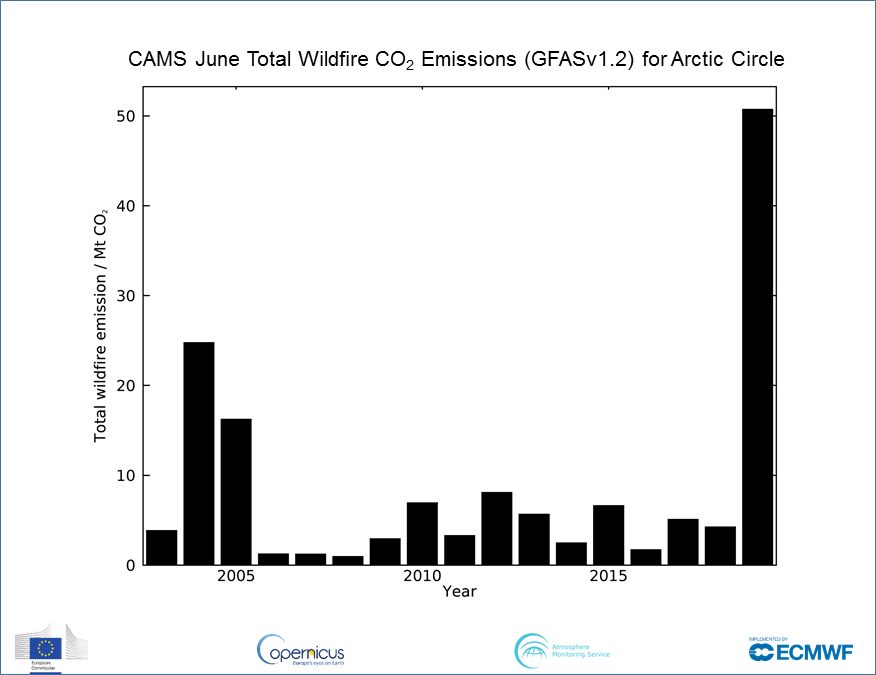
      After a record-breaking heatwave in Arctic, wildfires spread across the areas of Greenland, Siberia, and Alaska at unprecedented levels, surpassing last month's 50 megatonnes CO2 emissions record.

      I think it's fair to say July Arctic Circle wildfires are now at unprecedented levels having surpassed previous highest Copernicus GFAS estimated July total CO2 emission (2004/2005), & last month's 50 megatonnes, and still increasing. —Mark Parrington, senior scientist at ECMWF

      To see the 50 Mt in context, it is the equivalent to 2017 full year’s worth of national fossil fuel CO2 emissions for Bulgaria, Hungary and Sweden.

      photo: Copernicus Atmosphere Monitoring System (CAMS); desc: June Total Wildfire CO2 Emissions for Arctic Circle;

      Approximately 100 Mt CO2 emitted by Arctic wildfires between 1 June & 21 July 2019 is getting close to 2017 fossil fuel CO2 emissions of Belgium. Those are huge numbers and it's no brainer that wilfires’ smoke is a significant source of CO2 emissions.

      Heavy smoke circulation

      You can see a predicted circulation of heavy smoke directly in the Copernicus Atmosphere Monitoring System (CAMS) layer on Windy (Aerosol layer).

      Or watch the short video depicting predicted circulation of heavy smoke, from many Krasnoyarsk Krai and Central Russia wildfires, around giant low over next 2 days (satellite imagery below).

      To imagine how big the wildfires are in Russia, Alex Kokcharov, who is a Country risk analyst focused on Russia, Ukraine, Belarus, Eurasia and Caucasus, gives you a nice example.

      In Krasnoyarsk and Irkutsk regions, Siberia, eastern Russia, some 900,000 hectare (or equivalent to entire land area of Cyprus or Lebanon) is affected by forest fires.

      photo: fires.ru;Wildfires in Russia;

      Wildfires satellite imagery

      Pierre Markuse has amazing Flickr gallery of satellite images on the subject. Below are just few examples of how hard were Russia and Alaska hit by the wildfires.

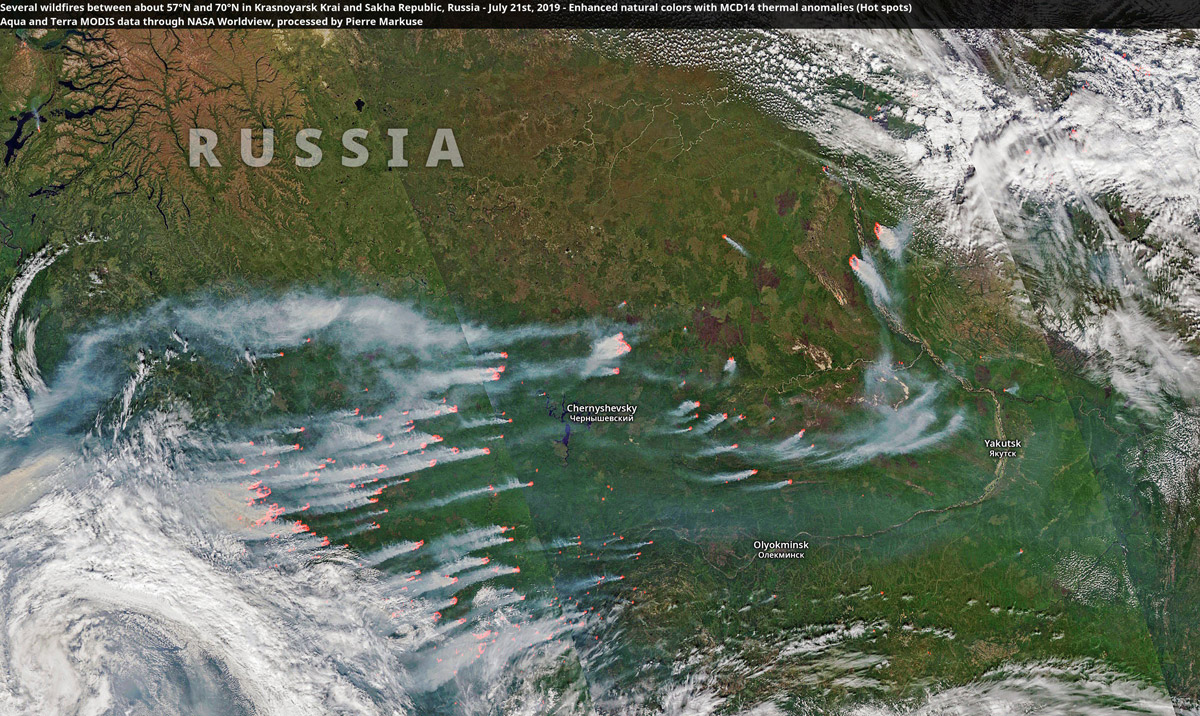
      Wildfires in Krasnoyarsk Krai and Sakha Republic

      21 July 2019

      Several wildfires and smoke plumes between about 57°N and 70°N in Krasnoyarsk Krai and Sakha Republic, Russia. Aqua and Terra MODIS data through NASA Worldview.
      
      photo: Pierre Markuse; desc: Processed Aqua and Terra MODIS data through NASA Worldview; licence: cc;

      Download this image in the original 4128 x 5040 px resolution here

      Wildfires east of Batagay, Verkhoyansky District

      16 July 2019

      About 67.8°N, east of Batagay, Verkhoyansky District, Sakha Republic, Russia

      photo: Pierre Markuse; desc: Contains modified Copernicus Sentinel data; licence: cc;

      Download this image in the original 9930 x 5040 px resolution here.

      photo: Pierre Markuse; desc: Contains modified Copernicus Sentinel data; licence: cc;

      Download this image in the original 9930 x 5040 px resolution here.

      Wildfires near Lena River

      16 July 2019

      About 66°N just south of the Arctic Circle near the Lena River, Sakha Republic, Russia

      photo: Pierre Markuse; desc: Contains modified Copernicus Sentinel data; licence: cc;

      Download this image in the original 1799 x 1926 px resolution here.

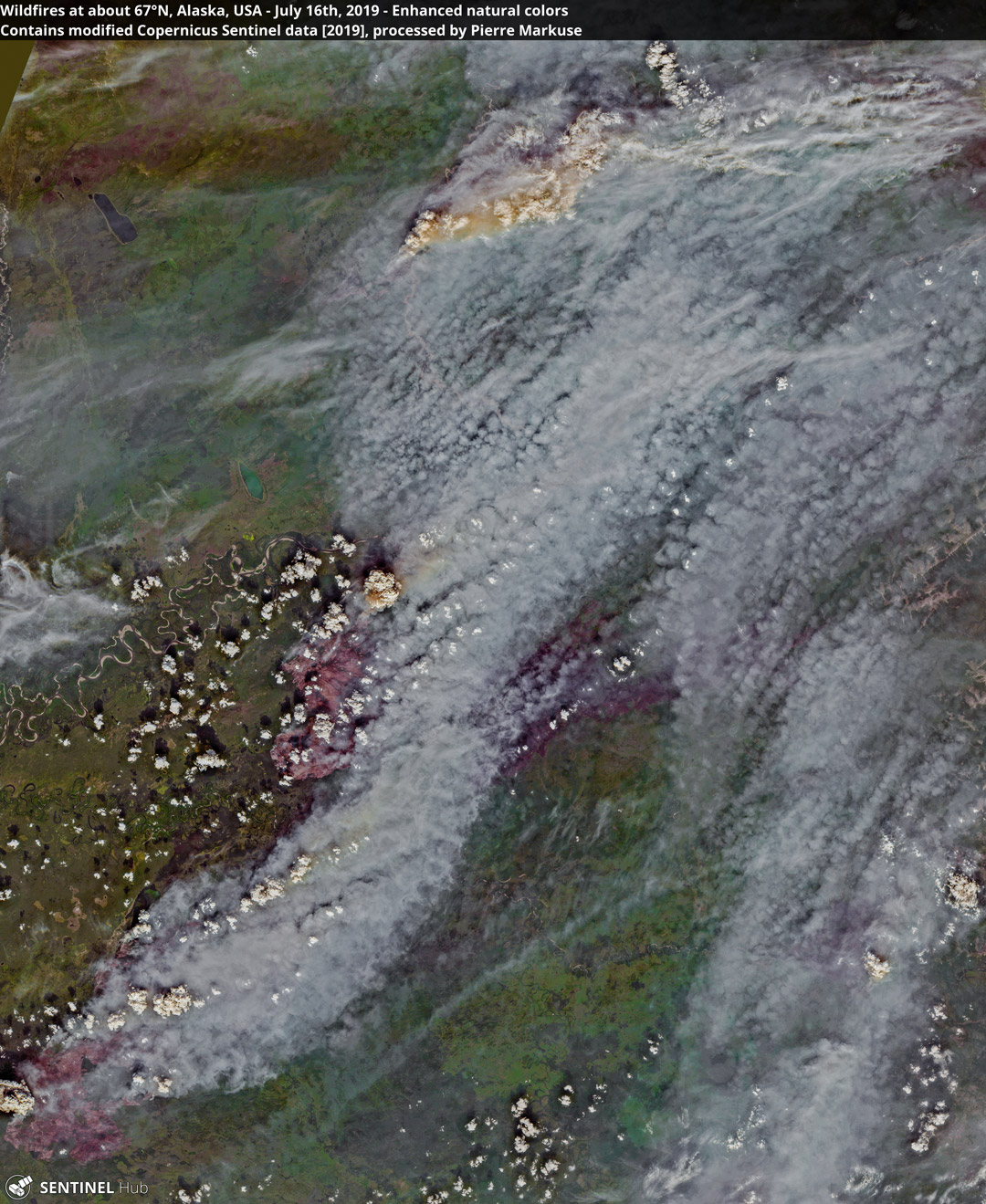
      Wildfires in Alaska

      16 July 2019

      Wildfires at about 67°N, Alaska, USA

      photo: Pierre Markuse; desc: Contains modified Copernicus Sentinel data; licence: cc;

      Download this image in the original 4128 x 5040 px resolution here

      Wildfire activity in the Arctic Circle in June 2019

      Unprecedented wildfire activity in the Arctic Circle in June 2019, with notable widespread fires in Sakha Republic, Russia for much of the last 3 weeks, as estimated with CAMS Global Fire Assimilation System (GFAS) data based on MODIS.

      photo: Copernicus Atmosphere Monitoring System (CAMS); desc: Total Fire Radiative Power for Arctic Circle, 1-30 June 2019;

      photo: Copernicus Atmosphere Monitoring System (CAMS); desc: Total Fire Radiative Power for Arctic Circle;

      photo: Copernicus Atmosphere Monitoring System (CAMS); desc: Daily Total Fire Radiative Power for Arctic Circle;

      Related links

      • The next BIG THING
      • Video of the week: Scientist captures sled dogs walking on Greenland's melting ice sheet
      • Why it doesn't matter what the climate-models tell us about the global warming
      • Extreme heatwave in Alaska: Anchorage hits highest temperature on record
      • Fossil CO2 emissions of all world countries, 2018 report
      posted in Articles article arctic circle wildfires russia alaska
      pavelneumanP
      pavelneuman
    • Is Global Warming a Hoax? See this picture

      Greenland: Rapid melt and sea ice with low permeability and few cracks leaves the melt water on top

      According to Rasmus Tonboe's tweet, climate researcher Steffen M. Olsen had a tough job in North West Greenland this year while he was retrieving an oceanographic moorings and weather station on sea ice. "Rapid melt and sea ice with low permeability and few cracks leaves the melt water on top", Tonboe adds in his tweet.

      In a huge thread below the tweet, Steffen M. Olsen, who is also the author of the heartbreaking picture, gives us more details about the conditions at the spot.

      We know the ice is around 1.2m thick and that we have about 870m water below us. Together with the local hunters we have been meassuring also ice thickness from December to now. An ongoing activity for almost a decade now.

      The photo was taken on Thursday 13th june around mid afternoon local time on sea ice, near Qaanaaq, middle of Inglefield Fjord, 77N.

      https://www.windy.com/annotation/5d0b61202292900019bc4c58

      posted in Articles article qaanaaq greenland climate change global warming
      pavelneumanP
      pavelneuman
    • Greta Thunberg's 3,000 miles long #ZeroCarbon journey
      • Update: Don't miss our day-by-day recap of the journey. Click here

      Swedish teenage climate change activist Greta Thunberg will spend two weeks travelling across the North Atlantic, to send a signal that "the climate change crisis is a real thing". Her goal is to attend a crucial climate change conference in New York.

      Climate change is still a controversial topic and that’s exactly why we need people like Greta - to spread the debate further.

      Scientists and weather nerds already pretty much agree on consensus climate change is not just real, but it seems we people are responsible and we should take much “greener” stance, starting with decarbonization ASAP (don’t miss this this huge post about decarbonization Ivo wrote couple of weeks ago).

      Even if you don’t believe that CO2 pollution is the main cause and you think the proof is not scientific, you should take a “greener” stance, given what we know about complex system (climate is complex system).

      photo:Windy.com;desc:Malizia II trackrer with Greata on board;link:https://www.windy.com/greta-thunberg ;

      Back to Greta and her journey. Before I get to the details, let me tell you, how surprised I was, when I found out Greta gets a quite a lot of criticism too - I’d rather say hate.

      The hate goes from basic climate change deniers stuff, up to the accusations of child abuse with some hidden agenda, that kind of stuff. And—despite depressing comments you can see below—that’s a good thing. To make something that stands out, you get not only supporters, you get a lot of hate too. I take it as a sign Greta is doing great job.

      Malizia II, the boat she’s travelling across the North Atlantic on, is a boat with no toilets, kitchens or privacy. The electricity on the boat will solely come from water turbines, or in the sailing world known as hydro generators, and solar panels, meaning the journey has a zero carbon footprint.

      photo:team-malizia.com;desc:Malizia II at 2017 Rolex Fastnet race;

      Professional sailor Boris Herrmann (38), who lives in Germany and is preparing for 2020 Vendée Globe (as the only German racer), is on board. Other crew members are her dad Svante, Pierre Casiraghi (co-skipper and founder of team malizia) and Nathan Grossman (close friend of Thunbergs and film maker).

      We consider ourselves members of the supporters camp, and that’s why we decided to give Greta some coverage. Our friends from Follow My Challenge built a Windy plugin tracking Greta's journey, that makes it possible follow her path in realtime. You can view the tracker at https://www.windy.com/greta-thunberg

      Recap & few more interesting facts:

      • The journey from UK to NY, where UN Climate Action Summit 2019 will take place, takes about 10-14 days, depending on the weather and waves
      • Approx 3,000 miles long journey begun on August 14th 2019 at 3 p.m. local time
      • The 60 feet long and 20 feed wide ship is called Malizia II. Malizia means "the wily"
      • She has not mentioned how he will return back to Europe

      Departure in Plymouth

      photo:Andreas Lindlahr / team-malizia.com;desc:Departure of Greta Thunberg

      photo:Andreas Lindlahr / team-malizia.com;desc:Departure of Greta Thunberg

      • Watch more videos from the departure here

      Related content

      • Windy founder's message to Greta
      • Watch Greta Thunberg leaving Plymouth

      https://www.windy.com/annotation/5d52dd2d1cec4500191ba6fc

      posted in Articles greta thunberg malizia ii climate change article decarbonization
      pavelneumanP
      pavelneuman
    • Typhoon Mitag (Onyok) coverage
      • Update: Weakening Mitag makes landfall in South Korea. At 12:00 p.m. UTC, Tropical Storm Mitag was located near 34.4N 126.3E, with max. sustained winds of 40 knots, with higher gusts of 50 kt. Here's the latest cone & track forecast (JTWC Warning #22). photo:JTWC;desc:Tropical Storm Mitag cone (Warning 22)
      • Update: We've uploaded the latest MItag cone and track forecast (JTWC warning #19) to Windy. Click here to view it on any Windy layer.
      • Update: Mitag, weakened to a Tropical Storm (what does it mean? Find out in this article: Four stages of Tropical Cyclone), continues to weaken gradually as it begins to curve northeast, headed toward landfall overnight Wednesday on Korea's southwest coast and forecast to cut across the south-central part of the peninsula . At 6:00 p.m. UTC, Tropical Storm Mitag was located near 30.7N 122.7E, with max. sustained winds of 55 knots, with higher gusts of 70 kt.
      • Update: We've uploaded the latest JTWC's Typhoon Mitag cone to Windy (warning #18). Click here to view it on any Windy layer.
      • Update: Mitag is weakening off the coast of eastern China, expected to impact the Korean peninsula and Area IV starting tomorrow. At 12:00 p.m. UTC, Tropical Storm Mitag was located near 30.0N, 122.5E, with max. sustained winds of 60 knots (110 km/h). According to the U.S. Army Garrison Daegu facebook post, Typhoon Mitag is expected to impact the Korean peninsula and Area IV starting tomorrow, Oct. 2, at 2 p.m. lasting until Thursday late evening, Oct. 3. Winds are expected to reach 50-60 nautical miles per hour (knots) along the southern coastline of Korea and the southern most portions of Area IV with 3 to 6 inches of rainfall expected. Other areas of Area IV will likely experience elevated winds of 35-45 knots and 3 to 4 inches of rainfall. photo:JTWC/SATOPS;desc:Typhoon Mitag on October 1st at 12:00 p.m. UTC
      • Update: At 12:00 a.m. UTC, Typhoon Mitag was located near 27.2N 122.1E with max. sustained winds of 75 knots, with higher gusts 90 kt. JTWC's cone and track forecast (warning #16) is now uploaded to Windy. View it on any forecast layer
      • Update: Mitag has strengthened again. At 6:00 p.m. UTC, Typhoon Mitag was located near 26.3N, 122.7E, with max. sustained winds of 90 knots and gusts of 110 knots. JTWC Warning #15. photo:JTWC;desc:Warning #15
      • Update: At 12:00 p.m. UTC, Typhoon Mitag was located near 24.6N 123.0E with max. sustained winds of 85 knots, with higher gusts of 105 kt (JTWC Warning #14)
      • Update: Typhoon Mitag is strengthening. At 6:00 a.m. UTC, Mitag was located near 22.8N 123.0E with max. sustained winds of 75 knots, with higher gusts of 90 kt (JTWC Warning 13).
      • Update: At 12:00 a.m. UTC, Typhoon Mitag was located near 21.7N 122.9E with max. sustained winds of 65 kt, with higher gusts of 80 knots (View the JTWC Warning 12 cone).
        photo:JTWC/SATOPS;desc:Typhoon Mitag at 12 a.m. UTC
      • Update: At 6:00 p.m. UTC, Typhoon Mitag was located near 21.1N, 123.7E with max. sustained winds of 65 kt, with higher gusts of 80 kt (JTWC Warning 11). We've uploaded the latest Typhoon Mitag cone & track forecast by JTWC (Advisory #11), click here to view its interactive version on any Windy layer.
      • Update: Mitag has stenghtened to a Typhoon. At 12:00 p.m. UTC, Typhoon Mitag (19W, or Onyok in Philippines) was located near 20.2N 124.7E, approximately 415 NM south-southwest of Kadena AB, with max. sustained winds of 65 kt, gusts of 80 kt. Mitag has tracked northwestward at 12 knots over the past six hours. Maximum significant wave height at 12:00 p.m. UTC is 27 feet (JTWC Warning #10).

      • (Click here to view an interactive warning #10 cone on any Windy layer)

      photo:JTWC/SATOPS;Typhoon Mitag - 29 Sept. at 12 p.m. UTC

      • Update: We've uploaded the latest JTWC cone to Windy (warning #7). Click here to view it on any Windy layer.
      • Update: Early on Saturday, Mitag (19W, Onyok) strengthened to Tropical Storm, earning its name, and becoming the 18th tropical storm of the season. Mitag is forecast to affect Taiwan, China, South Korea and Japan.

      Previous coverage

      photo:Windy.com;desc:10-Day max. winds forecast (ECMWF updated on 26 Sept 2019 at 12 p.m. UTC);licence:cc

      A developing tropical disturbance (Invest 91W) in the West Pacific is becoming better organized, forecast to become a strong typhoon as it heads towards Japan and Korea.

      The system is forecast to strengthen into Tropical Storm Mitag over the Philippine Sea by Friday/Sunday, then a typhoon this weekend.

      photo:JTWC/SATOPS;Tropical Warnings. Image Time: 26/1730Z

      According to JTWC, significant intensification is possible the next several days. Mitag will impact the Ryukyu Islands early next week, then mainland Japan around midweek.

      Here’s the 10-Day max. winds forecast, a comparison of the forecast models, updated on 26 Sept 2019 at 12 p.m. for ECMWF and at 6 p.m. UTC for GFS.

      photo:Windy.com;desc:10-Day max. winds forecast model comparison;licence:cc

      https://www.windy.com/upload/5d94aa763f5ac70019c10d97?satellite,24.966,125.859,4,internal

      posted in Articles article typhoon typhoonseason mitag 91w
      pavelneumanP
      pavelneuman
    • More useful tools for weather geeks. The list of Windy plugins

      Windy Plugins, a great way to extend the functionality of Windy (if you're not familiar with Windy, it's an extraordinary tool for weather forecast visualization that is 100% free).

      To load a plugin, simply insert its short name to www.windy.com/plugins (or access it via Install Windy plugin menu item)

      This page will be updated with new plugins regularly. Developer? You can code your own plugin too!

      Airspaces

      Short name: airspaces (plugin's page) coded by @rittels

      photo: Windy.com; desc: Airspaces plugin by <a class=@rittels;" class=" img-fluid img-markdown" />

      The first ever Windy plugin! The name says it all. Airspaces plugin adds airspaces, the portions of the atmosphere controlled by a country above its territory, to any map on Windy. It extends the picker with airspace's info.

      Density Altitude

      Short name: da (plugin's page) coded by @rittels

      photo: Windy.com; desc: Density Altitude plugin by <a class=@rittels" class=" img-fluid img-markdown" />

      Extends the picker with density altitude data. The density altitude is the air density given as a height above mean sea level. The density altitude can also be considered to be the pressure altitude adjusted for a non-standard temperature.

      Flight Planner

      Short name: fp (plugin's page) coded by @rittels

      photo: Windy.com; desc: Flight Planner plugin developed by <a class=@rittels" class=" img-fluid img-markdown" />

      Weather forecast, flight planning and airspaces at once. A great extension for pilots. To get started, read this short tutorial on how to use Flight Planner.

      iWaethar Stations (South African Weather Stations)

      Short name: iw (plugin's page) coded by @rittels

      photo: Windy.com; desc: iWaethar Stations plugin developed by <a class=@rittels" class=" img-fluid img-markdown" />

      It's great feature to have observed weather data and the forecast at your fingertips, just as you have it on Windy. On other hand, it's not trivial to set up a weather station properly and wrong setup can easily kill the reliability of the reported data.

      iWeathar Stations plugin solves this problem for South Africa, providing data from iweathar.co.za.

      Once you'll load this plugin, you can access iWeathar weather stations via context menu (right click on a map). Click on the station to open its details in the left pane.

      SA Weather Service Warnings

      Short name: saws-warnings (plugin's page) coded by @rittels

      photo: Windy.com; desc: iWaethar Warnings plugin developed by <a class=@rittels" class=" img-fluid img-markdown" />

      Similarly as the iWeathar Stations, another plugin by @rittels, SA Weather Service Warnings plugin provides the data from iweathar.co.za, in this case the weather warnings.

      SkewT

      Short name: skewt (plugin's page) coded by @johnckealy

      photo: Windy.com; desc: SkewT plugin by <a class=@johnckealy" class=" img-fluid img-markdown" />

      Although Windy has its own Sounding diagram built in, you may prefer a Skew-T style diagram. Then you'll love the SkewT plugin by John Kealy. Great for thunderstorms forecasting.

      Sun position

      Short name: sun-position (plugin's page) coded by @jacobjo

      photo: Windy.com; desc: Sundial, sunrise and sunset times by @jacobjo

      Sun position plugin adds sundial to Windy's picker. Moreover, if you'll activate the Sun Position layer, you'll get details about sunset and sunrise times. Read more...

      Trajectory

      Short name: traj (plugin's page) coded by @rittels

      photo: Windy.com; desc: Trajectory plugin by <a class=@rittels" class=" img-fluid img-markdown" />

      For hot air ballooners and aviation geeks, air trajectories are the tool of choice. Trajectories show the air movement for the selected altitude level. Now available on Windy.

      WaterWatch (USA river flows)

      Short name: waterwatch (plugin's page) coded by @rittels

      photo: Windy.com; desc: WaterWatch, a streamflow plugin developed by <a class=@rittels" class=" img-fluid img-markdown" />

      Watch the rivers flow. WaterWatch plugin extends any Windy layer with real-time streamflow compared to historical streamflow for the day of the year (United States). Data by USGS, see legend below.

      photo:USGS;desc: Streamflow datapoints legend

      posted in Articles windy plugins skew-t streamflow sun article
      pavelneumanP
      pavelneuman
    • Weather forecast, flight planning and airspaces at once. A great extension for pilots

      photo:Flight Planner; desc: Load a plugin; link:https://www.windy.com/plugins

      Pilots will love this flight planning tool. Although Windy recently released its own route planner (Distance & planning) that has VFR chart built in, this plugin is coded specifically for pilots. It extends Windy's forecast layers with feature-rich flight planning and airspaces (Airspaces is available as a separate plugin too - see our list of Windy plugins).

      Here's a short tutorial on how to use Flight Planner plugin..

      Getting started

      To load Flight Planner plugin, enter it's short name (fp) to www.windy.com/plugins and click Load plugin.

      Flight Planner screenshot

      After plugin is loaded, you can access Flight Planner via contextual menu (right-click or long press).

      Flight Planner screenshot

      Now you can use the weather picker to add a waypoint.

      Flight Planner screenshot

      Or click an airport icon to add a waypoint.

      Flight Planner screenshot

      Flight Planner screenshot

      You can also use the search option to add a waypoint.

      Flight Planner screenshot

      Or enter coordinates in the search bar.

      Flight Planner screenshot

      You can also load a flight plan, supported formats: gpx/efp or ep1 (easycockpit or easyplan).

      Flight Planner screenshot

      1. You can set the altitude, airspeed and estimated time of departure for each leg. To set the time, select a single leg, by long-pressing the row.
      2. Once the flightplan is completed, you can drag the aircraft icon to view the weather at the point where you will be, and at the selected time and level. The program will use the interpolator function to obtain the weather info for the current overlay.
      3. For wind: the ground speed is calculated and the aircraft icon will crab.

      You can also use the elevation strip at the bottom, to move the aircraft icon.

      The plugin can collect the weather data for overlays that you select.

      Flight Planner screenshot

      1. First select the overlays and select alert values.
      2. Then click Read Wx. The program will zoom in and fly along the route to collect the weather data for each overlay. This will take a few seconds, but can take about a minute for a long route. Do not drag the map while this is happening.
      3. When you now slide the aircraft icon, all the selected data will be shown in the box.

      Once the Wx data have been collected, the program will calculate the corrected ETE, average ground speed and the ETE for the entire trip.

      Flight Planner screenshot

      You can also drag waypoints, first click "allow drag" (1) then drag them to the new position (2) and click OK. Then "lock drag" (1) again, to prevent accidentally dragging when sliding the aircraft icon.

      Flight Planner screenshot

      The plugin contains the previous airspaces plugin, airspace data is obtained from openAIP.net.

      Flight Planner screenshot

      posted in Articles article tutorial flight planning route planning airspaces
      pavelneumanP
      pavelneuman
    • The best photo of the Etna volcano eruption you've ever seen

      Recently we had an article about the perfect Monsoon, now here’s a one about the perfect shot. Don’t worry, it’s weather related.

      I am sure you won’t disagree, if I'll tell you the picture of lenticular cloud over erupting Etna — you can see below — is the perfect shot.

      photo: Dario Giannobile;desc: Earthshine Moon and Lenticular Cloud Over Mount Etna Eruption

      If not the best shot of Mt. Etna you've ever seen, then it's at least one of the best, right?

      The picture was shot on 27 July 2019 as a single shot (Canon 6D, Canon 70-20mm, 4 sec, ISO 3200, f2.8) by Dario Giannobile from Palermo, Italy, who gives you more details on how did it “happened” (there’s also a 13 shots blend photo below the story).

      Here’s the story (formatting is mine)

      I was preparing to photograph the Moon that stood near the star Aldebaran. I had decided to go near the small town of Bronte, to the western side of the volcano Etna (Unesco Site), and wait for dawn.

      On the same day, however, Etna awoke and two cracks in the south-east crater began intense volcanic activity with the formation of two lava flows and sporadic pyroclastic material jets.

      The phenomenon could be observed from the south-south west slopes but despite having the possibility of going to the site, I decided to respect the initial plan.

      To my enormous surprise, I could see that some lenticular clouds aligned perfectly on the mountain top from the point of shooting I had initially chosen.

      The show was incredible!!!!....especially when the Moon rose.

      The most beautiful moment occurred when it passed behind the cloud allowing me to capture various celestial and terrestrial details

      The Moon in cinereal light whose brightness was partially shielded, the same lenticular cloud, iridescences spread over the edge of the cloud, contrasts of shadows and lights in the sky with the cloud that partially blocked the Moon rays leaving the stars in the dark sky visible and finally…. the eruption with the fountains and the lava flow.

      Star Trail and Lenticular Cloud Over Mount Etna Eruption

      photo: Dario Giannobile;desc: Earthshine Moon and Lenticular Cloud Over Mount Etna Eruption

      Blend 13 shots, Canon 6D, Canon 70-20mm, 8 sec, ISO 3200, f2.8

      Don’t miss other photos from Dario, you can follow him on Facebook, Twitter, Instagram (@dariogiannobile) or visit his website.

      Related links

      • Is it UFO or Altocumulus Lenticularis?
      posted in Articles article etna eruption lenticularis clouds
      pavelneumanP
      pavelneuman
    • Earthquakes of the 20th Century

      Earthquakes-of-the-20th-Century_cover.jpg

      Animation from NWS Pacific Tsunami Warning Center shows earthquakes of the 20th century.

      Earthquakes-of-the-20th-Century_01.png

      This animation shows every recorded earthquake in sequence as they occurred from January 1, 1901, through December 31, 2000, at a rate of 1 year per second. The earthquake hypocenters first appear as flashes then remain as colored circles before shrinking with time so as not to obscure subsequent earthquakes. The size of the circle represents the earthquake magnitude while the color represents its depth within the earth. At the end of the animation it will first show all quakes in this 100-year period. Next, it will show only those earthquakes greater than magnitude 6.5, the smallest earthquake size known to make a tsunami. It will then show only those earthquakes with magnitudes of 8.0 or larger, the “great” earthquakes most likely to pose a tsunami threat when they occur under the ocean or near a coastline and when they are shallow within the earth (less than 100 km or 60 mi. deep). The animation concludes by showing the plate boundary faults responsible for the majority of all of these earthquakes.

      The era of modern earthquake seismology—the scientific study of earthquakes—began in the 20th Century with the invention of the seismometer and its deployment in instrument networks to record and measure earthquakes as they occur. Therefore, when the animation begins only the largest earthquakes appear as they were the only ones that could be detected at great distances with the few available instruments available at the time. But as time progresses, more and more seismometers were deployed and smaller and smaller earthquakes could be recorded. For example, note how in the 1930’s many small earthquakes suddenly seem to appear in California, but this illusion results from the installation of more and more instruments in that region. Likewise, there appears to be a jump in the number of earthquakes globally in the 1970’s when seismology took another leap forward with advances in telecommunications and signal processing with digital computers, a trend that continues today.

      20th Century seismology revealed the global geographic distribution of earthquakes and helped to solidify the Theory of Plate Tectonics. Notice how earthquake epicenters do not occur randomly in space but form patterns over the earth’s surface, revealing the boundaries between tectonic plates as shown toward the end of this animation. This time period also includes some remarkable events, including those that generated devastating tsunamis:

      8.8 — Ecuador — 31January 1906
      8.4 — Kamchatka, Russia — 3 February 1923
      8.4 — Sanriku, Japan — 2 March 1933
      8.6 — Unimak Island, Aleutian Islands — 1 April 1946
      9.0 — Kamchatka, Russia — 4 November 1952
      8.6 — Andreanof Islands, Aleutian Islands — 9 March 1957
      9.5 — Valdivia, Chile — 22 May 1960
      9.2 — Prince William Sound, Alaska — 28 March 1964
      8.7 — Rat Islands, Aleutian Islands — 4 February 1965

      These earthquakes represent some of the largest ever recorded. Note how they all occur at a particular type of plate boundary, subduction zones where tectonic plates collide, so these are the regions where we expect future devastating tsunamis to be generated.

      posted in Articles article earthquakes weather history video
      pavelneumanP
      pavelneuman
    • Very severe cyclonic storm Vayu is not likely to make landfall on Gujarat coast
      • Update: Vayu is expected to be weak as it makes landfall over northern Gujarat on Tuesday, it could bring heavy rainfall to western and northern India over the next five days
      • Update: Vayu is beginning to rapidly succumb to dry mid-level air and increased easterly vertical wind shear, weakening to tropical storm-equivalent strength. (Currently: 60 knots | 977 mbar)
      • Update: Cyclone Vayu likely to turn into depression, parts of North Guj may receive rain showers on June17, 18
      • Update: "It remains practically stationary in last one hour about 240 km West of Diu (Gujarat) and 130 km nearly South-West of Porbandar (Gujarat)," IMD said.
      • Update: Danger over Gujarat has ended, says CM Vijay Rupani to India News. "The administration received over 2000 complaints related to the power failures, while 144 villages said complete power loss."
      • Update: Gujarat coast has narrowly escaped devastation, Vayu is located 130 km south of Porbandar, Gujarat. Max winds reaching 160 kph. Vayu is drifting away from Indian coast
      • Update: IMD has officially informed that the trajectory of Vayu cyclone has changed. Cyclone Vayu won't hit Gujarat. Still its effect will be seen on the coastal regions as there will be heavy wind speed and heavy rain.
      • Update: Vayu strengthened to Cat 3 Hurricane equivalent
      • Update: JTWC udated exposed population in cat 1 or higher from 490,000 to zero in it's latest estimates
      • Update: Vayu is now Cat2.Hurricane-strength Tropical Cyclone. JTWC udated it's impact estimates, exposed population in cat 1 or higher to 490,000 (was 3.5 million), and max. storm surge to 1.6 m (was 1.4). Scroll down to see an updated infographic
      • Update: Cyclone Vayu is very likely to move nearly northwards and cross Gujarat coast as a Very Severe Cyclonic Storm with wind speed 145-155 kmph gusting to 170 kmph around morning of 13th June 2019.
      • Update: We've added impact estimates by JTWC, see below

      Credits: GDACS (JTWC)

      June 13th
      Vayu forecast

      June 12th
      300,000 people are set to be evacuated to shelter homes, fishermen have been advised not to venture into sea along and off the Gujarat coast till June 15.

      Vayu is likely to damage thatched houses, blow away rooftops and metal sheets, disrupt power and communication lines and cause major damage to roads and crops.

      June 11th
      Tropical Cyclone Vayu (VAYU-19, IMD's identifier ARB 01) formed 10 June 2019 in the Arabian Sea and it heads towards Gujarat and Pakistan, expected to strengten to Category 1 hurricane (or more precisely, because we are in the Indian Ocean basin, the Cyclone) later today (UTC 2019-06-11T18:00:00.000Z or 11 Jun 2019 8:00 PM local time).

      Extremely heavy rains are expected across coastal India and over Pakistan.

      Vayu is the 3rd named storm of the 2019 North Indian Ocean cyclone season.

      The outlook

      GDACS (JTWC) expects maximum wind speeds 167 km/h, estimate of the exposed population in Category 1 or higher is 6.6 million.

      Vayu formed early on June 10 as a tropical depression in the Arabian Sea, northwest of the Maldives, and it gradually strengthened, becoming a Cyclonic Storm Vayu later that day.

      Expected impact of the tropical storm Vayu

      Unlikely to be as destructive as Fani, tropical storm Vayu will still have a huge impact on India. GDACS (JTWC) estimates Vayu will affect the popullation of 3.5 million in Category 1 or higher, with 176 km/h maximum sustained wind speed, maximum storm surge 1.4 m (13 Jun 05:00 UTC), ranked as High vulnerability for India.

      
photo: Windy.com;
link:;
licence: cc;
desc:Feel free to download the image and post it to your social media account, blog or website. Please mention our Facebook (<a class=@windyforecast), Twitter (@windyforecast) or Instagram account (@windy_forecast) when posting on social media or link to https://www.windy.com (thank you!) " class=" img-fluid img-markdown" />

      Get current forecast and stay safe

      photo: Windy;
desc: Actual position of Tropical Cyclone Vayu.;
licence:cc;

      To track the path of Vayu, check out the Windy hurricane tracker at https://www.windy.com/hurricanes regularly. We'll also update this post to reflect the latest development of the Cyclone Vayu.

      posted in Articles article indianocean cycloneseason cyclone tropicalcyclone
      pavelneumanP
      pavelneuman
    • Windy Tutorial: How to use a route planner

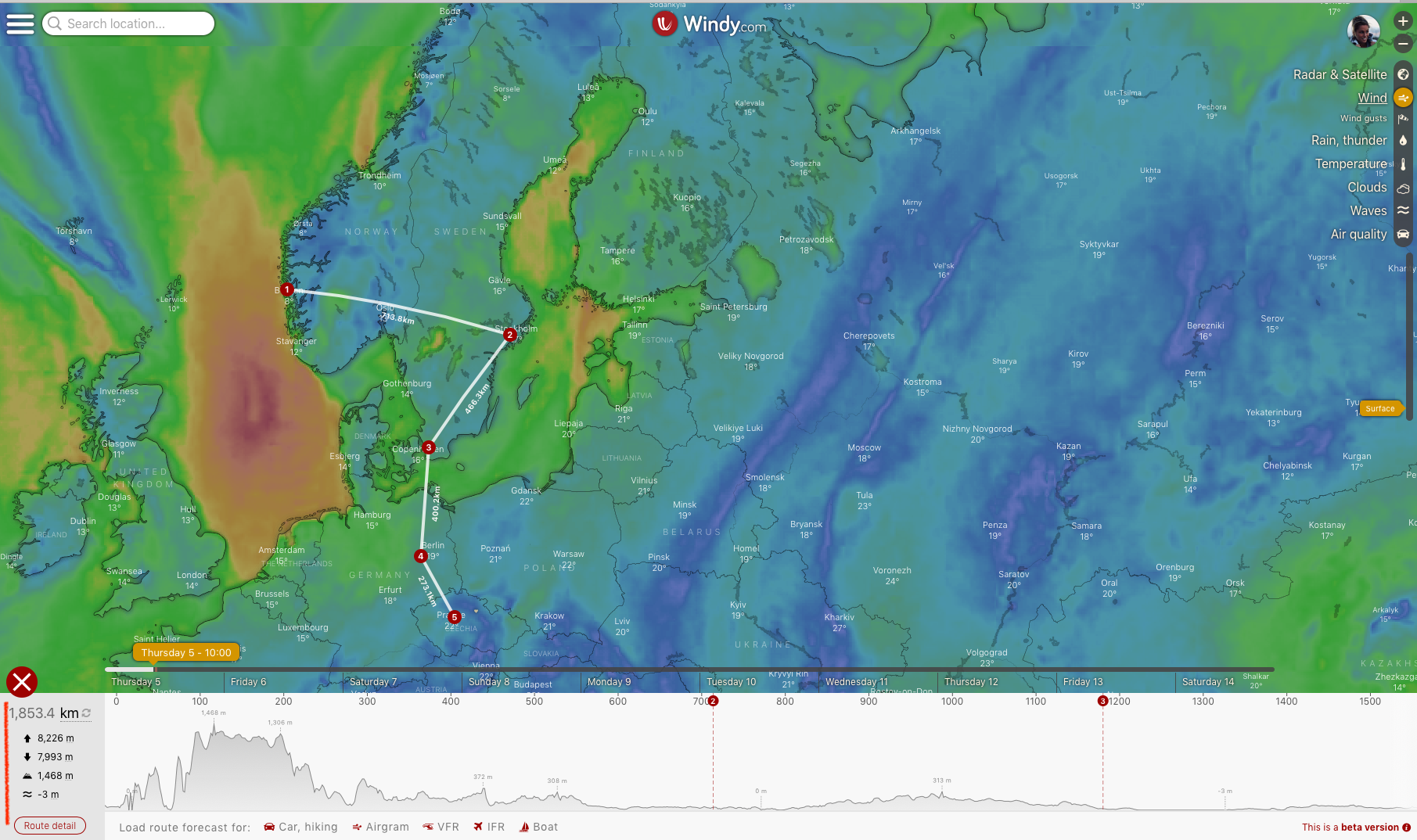
      Windy has a route planner with many functions. The route planner provides information for cars, boats, and airplanes as well. You can plan your trip to be as long as you want. We hope that this detailed description will be helpful for everyone!

      photo:Windy.com;desc:Route planning; licence:cc;

      In the left corner of the Elevation menu you can see units, which tells you how long the road is. By clicking on units, you can choose which units you need.

      Below the units are Total ascent, Total descent, Max elevation, minimal elevation and on the bottom is Route detail, which shows you geographic coordinates and also allows you to download a scheduled trip in GPX and KML format or share your route.

      • Total ascent = provides a total of all increases to elevation
      • Total descent = is the sum of all height differences of those parts of the track descending.
      • Maximal elevation = provides the highest elevation achieved
      • Minimal elevation = provides the minimal elevation achieved

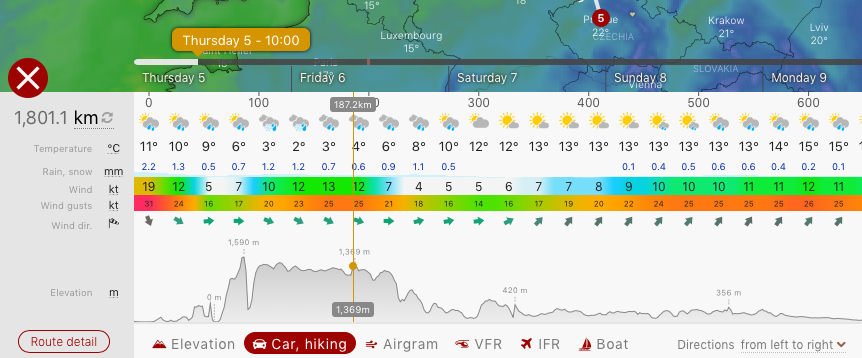
      Car, hiking

      photo:Windy.com;desc:Car and hiking route planning;licence:cc;

      • Temperature = How many degrees it will be during the trip
      • Rain, Snow (mm) = How many mm of rain/snow there will be during the trip
      • Wind (kt) = Force of constant wind
      • Wind gusts = A gust, or wind gust, is a brief increase in the speed of the wind, usually less than 20 seconds.
      • Wind direction = is reported by the direction from which it originates. For example, a northerly wind blows from north to south. In general, wind directions are measured in units from 0° to 360°, but can alternatively be expressed for -180° to 180°.
      • Winds are named for the direction from which they come, followed by the suffix -erly. For example, winds from the north are called “northerly winds” (north + -erly).

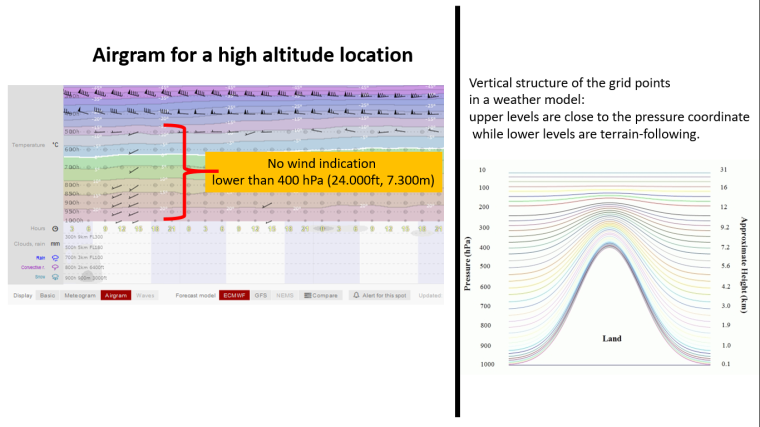
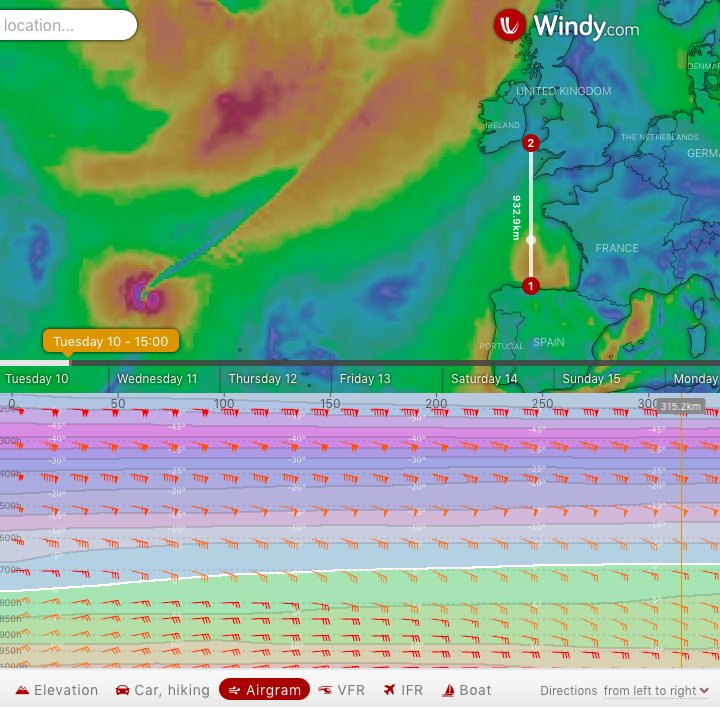
      Airgram

      photo:Windy.com/<a class=@Gkikas-LGPZ;desc:Airgram;licence:cc;" class=" img-fluid img-markdown" />

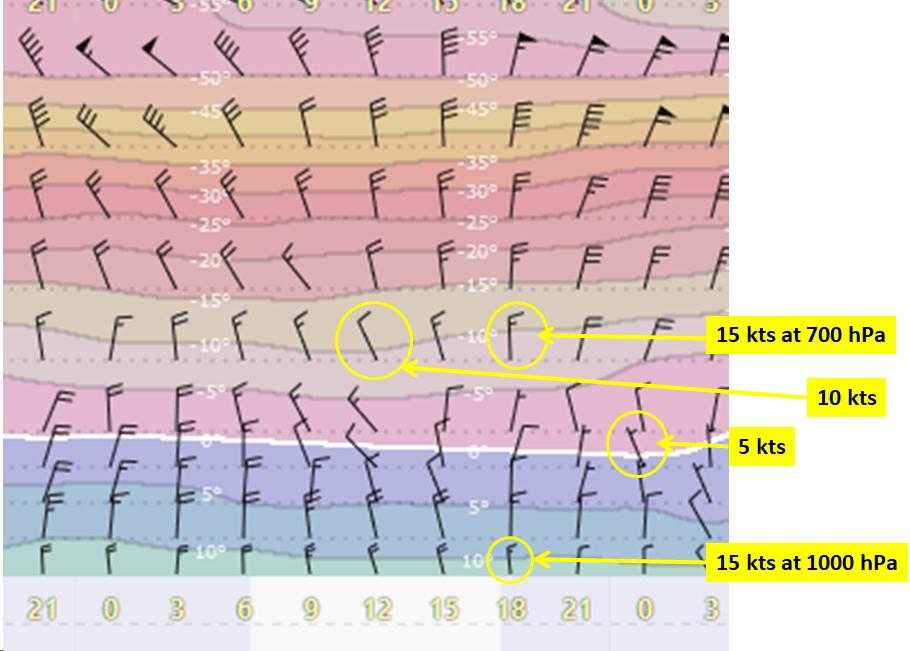
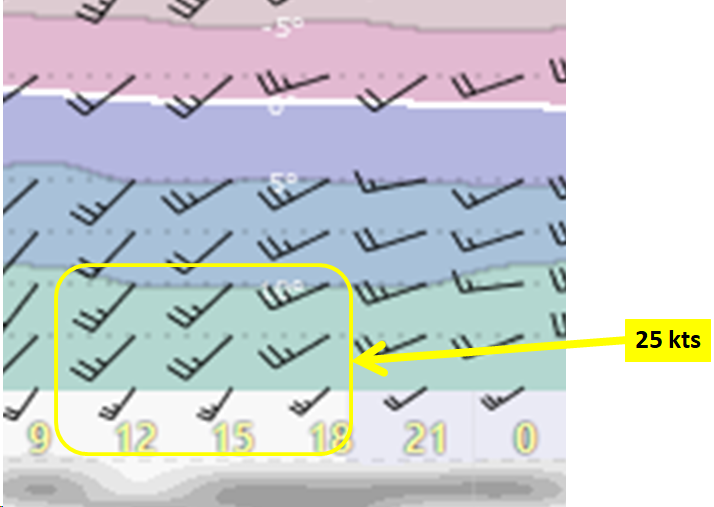
      • Symbols illustrate wind speed and direction
      • Windy symbols at lower levels (e.g. at 1000 hPa) are shown relatively smaller than the same symbols at higher levels
      • Lines labelled means pressure in hPa (hectoPascal)

      The “standard” pressure on the surface (sea level) is 1013 hPa. As we go up, the pressure falls, so at 850 hPa we are at an elevation of 1500m (5.000 ft) at 500 hPa, 18.000 ft etc

      The winds aloft are amsl. Actually are the winds on standard isobaric surfaces. For example the wind at 5000ft is actually the wind on a “surface” of the atmosphere where the pressure is 850 hPa.

      Over mountains those “isobaric surfaces” may intersect* (cut) the orography (land surface). Thus, if you point on Everest and choose wind at different altitudes you'll find out that wind “stays the same” at all levels from Om (msl) up to 8.000m.

      photo:Windy.com/<a class=@Gkikas-LGPZ;licence:cc;" class=" img-fluid img-markdown" />

      • Also here, all wind symbols show the same wind speed (25 kts)

      photo:Windy.com/<a class=@Gkikas-LGPZ;licence:cc;" class=" img-fluid img-markdown" />

      VFR

      photo:Windy.com;Visual flight rules (VFR);licence:cc;

      Visual flight rules are a set of regulations under which a pilot operates an aircraft in weather conditions generally clear enough to allow the pilot to see where the aircraft is going. The weather must be better than basic VFR weather minima, i.e. in visual meteorological conditions (VMC). The pilot must be able to operate the aircraft with visual reference to the ground, and by visually avoiding obstructions and other aircraft

      • Rain, Snow (mm) = How much mm of rain/snow there will be during the trip
      • Convective r. = thunderstorms during the trip
      • Clouds, rain (mm) = How many mm of clouds/rain there will be during the trip
      • Weather warnings
      • Cloud tops (m) = At what maximum height clouds are
      • Cloud base (m) = At what minimum height clouds are
      • Surface visibility (km) = Surface visibility during the trip
      • Dew point spread (°C) = Dew point spread during the trip

      IFR

      photo:Windy.com;desc:Instrument flight rules (IRS);licence:cc;

      Instrument flight rules (IRS) is one of two sets of regulations governing all aspects of civil aviation aircraft operations; the other is visual flight rules.

      When operation of an aircraft under VFR is not safe, because the visual cues outside the aircraft are obscured by weather, instrument flight rules must be used instead.

      ATC monitors IFR flights on radar, or through aircraft position reports in areas where radar coverage is not available

      • ISA difference = International Standard Atmosphere, is a model for the standardization of aircraft instruments
      • Weather warnings
      • Cloud tops = At what maximum height clouds are

      Boat

      photo:Windy.com;desc:Boat route planning;licence:cc;

      • Temperature = How many degrees it will be during the trip
      • Rain, Snow (mm) = How many mm of rain/snow there will be during the trip
      • Wind (kt) = Force of constant wind
      • Wind gusts = A gust, or wind gust, is a brief increase in the speed of the wind, usually less than 20 seconds.
      • Wind direction = is reported by the direction from which it originates. For example, a northerly wind blows from north to south. In general, wind directions are measured in units from 0° to 360°, but can alternatively be expressed for -180° to 180°.
      • Waves = How big the waves will be and their direction

      Direction of the wind


      How to choose your direction on the map

      • Our automatic settings is LEFT TO RIGHT, but you can choose between 3 options
      • On these pictures you can see 3 maps with the same road but with a different direction of wind

      NORTH UP = absolute direction of wind, direction of movement has no influence (ie. if the arrow or sign imply the direction to the top - the wind is blowing from the south, to the left - it’s blowing from the east etc...)

      BOTTOM TO TOP = relative direction of wind, when the azimuth of the user in exact point is turned upwards, ie. when the user is moving from from the west to the east and the wind is blowing from the north to the south, the direction of the wind will be showing from left to right

      LEFT TO RIGHT = it’s the same situation, just the azimuth is rotated 90 degrees to the right, ie. if the user is moving from the west to the east and the wind is blowing from the north to the south (same situation as previously), the direction of the wind will be showing from the top to bottom

      alt text

      posted in Articles article windy tutorial route planning route planner how-to
      pavelneumanP
      pavelneuman
    • Saharan dust blowing over the Atlantic prevents storms during hurricane season

      Saharan dust is blowing over the Atlantic Ocean

      Another wave of Saharan dust is blowing over the Atlantic Ocean as seen in this GOES East loop from 18 June 2019.

      Large quantities of dust entering the Atlantic during hurricane season help create a stable layer of dry, sinking air, which prevents storms from spinning up or gaining strength.

      Each year, some 40 million tons of Saharan dust gets transported across the Atlantic - some of it reaching as far as the Amazon River Basin. The minerals in the dust replenish nutrients in rainforest soils, which are continually depleted by drenching, tropical rains.

      Credits: NOAA Satellites

      posted in Articles article atlantic hurricaneseason saharan dust
      pavelneumanP
      pavelneuman
    • Extreme storms over Europe with damaging wind gusts, very large hail and excessive rainfall

      photo:ESTOFEX;desc:Storm Forecast

      Valid: Sun 07 Jul 2019 06:00 to Mon 08 Jul 2019 06:00 UTC
      Issued: Sat 06 Jul 2019 21:33
      Forecaster: PUCIK

      • A level 3 was issued across NE Italy, Slovenia, N Croatia and N Bosnia mainly for damaging wind gusts, large to very large hail and excessive rainfall.
      • A level 2 was issued across N Italy, N Adriatic, N Bosnia, N Serbia into extreme W Romania mainly for large to very large hail and damaging wind gusts.
      • A level 2 was issued across E Slovakia into SW Ukraine and extreme NW Romania mainly for large to very large hail, severe wind gusts and excessive rainfall.
      • A level 1 was issued across Massif Central, N Alpine forelands mainly for large hail, excessive rainfall and severe wind gusts.
      • A level 1 was issued across Romania, Ukraine and Belarus mainly for severe wind gusts and large hail.
      • A level 1 was issued across E Spain mainly for severe wind gusts and large hail.
      • A level 1 was issued for the Caucasus region mainly for excessive rainfall and severe wind gusts.

      Synopsis

      In a broad belt of strong zonal flow at mid to upper troposphere, several short-waves troughs are forecast to track from the Northern Sea through N Poland towards the Baltics and Russia. At the same time, closer to the surface, a low pressure system will move from the Baltic Sea towards Russia.

      Associated cold front, which will be located over N France, S Germany, Czech Republic and SE Poland on Sunday 06 UTC, will move towards the Alpine range and cross Austria, Hungary, much of Romania and Ukraine by the next morning.

      As strong mid-tropospheric flow will overlap moist boundary layer ahead of the front, large area over Europe, in a belt from E France towards Belarus, may experience at least isolated severe convective storms.

      Discussion

      N Italy towards W Romania

      A severe weather outbreak is forecast over the area given overlap of 15 - 25 m/s of DLS with 1000 to 3000 J/kg of MLCAPE, yielding high probabilities of severe weather in any convective storm that forms.

      Scattered to widespread coverage of storms is forecast from NE Italy to Romania with cold front serving as a lift factor of virtually uncapped airmass.

      Coverage of storms becomes more questionable over NW Italy, given the fact that cold front does not reach this area and initiation will likely depend on the local topography.

      Abundant convective activity may already be ongoing over the Alpine range and over N Italy / Slovenia on Sunday morning. Given the environment, this activity may already be severe and may impact the consequent development over the northern part of the area.

      As day progresses, further rounds of severe convective storms are forecast. It is likely that isolated supercells will form on the Alpine and N Appenines foothills in the early afternoon to evening hours and progress SE-wards, merging into one or more convective systems.

      High res NWP currently suggests that one such system may cross from NE Italy towards the Adriatics and another one from Slovenia towards Croatia, N Bosnia and Serbia. Towards the late evening and night hours, storms are forecast to reach and/or initiate over Romania.

      Large to very large hail will accompany supercells, while well organised systems, including bow-echoes, may produce multiple swaths of damaging wind gusts.

      Tornado threat will be low initially given weak low level shear, but may increase towards the evening with strengthening wind field around the Adriatic Sea.

      Level 3 is introduced for the region where widespread storm activity is simulated in high CAPE and strong shear parameter space.

      N Alpine range and forelands

      Widespread storms are forecast to form early in the day over the region. The storms will form in the environment of skinny CAPE profiles and 15 to 20 m/s of DLS.

      While several supercells and well organised multicells are likely, updraft speed will be limited by lack of large buoyancy in mid troposphere. This reduces the risk of large to very large hail compared to the area south of the Alpine range.

      Furthermore, lack of strong lower tropospheric shear and moist boundary layer reduce the threat of damaging wind gusts. At the same time, mean storm motion of 15 m/s reduces the risk of excessive rainfall.

      While Lvl 2 was considered for the area, it does not seem that environment will favour widespread form of any particular type of severe weather threat and Lvl 1 seems sufficient at the moment.

      E Slovakia into SW Ukraine and NW Romania

      Carpathians are forecast to deform the passage of the cold front and while it surges across the Hungarian plains, E Slovakia and adjacent areas will remain in the warm and unstable airmass.

      After the first overnight round of convection, the first storms are forecast to initiate over NE Slovakia and will spread SE-wards during the day. DLS between 20 and 25 m/s will favour supercells with threat of large to very large hail and severe wind gusts.

      Lack of steep lapse rates may somewhat reduce the hail risk outside the supercellular convection. It is likely that storms will eventually merge into one or more bow-echoes, which will profit from more than 15 m/s of 0-3 km shear, shifting the primary threat from large hail to severe wind gusts.

      Romania into Ukraine and Belarus

      Isolated to scattered thunderstorms are forecast to form along the fast moving cold front in the environment of 20+ m/s of DLS. Straignt hodographs suggest splitting supercells and linear segments, posing threats of large hail and severe wind gusts.

      Severe weather threat will be mitigated to some degree by lack of steep lapse rates and weak buoyancy in the mid-troposphere.

      E Spain

      Combination of large Inverted-V in the forecast hodographs along with strong flow near the LCLs suggest an enhanced threat of severe wind gusts in any storms that form during the day.

      Towards the coastline, higher CAPE values may also allow for large hail in high-based, rotating storms forming in DLS of around 20 m/s. While initiation is highly uncertain, will keep a Lvl 1 over the area.

      The ESTOFEX forecasts are published under a Creative Commons Attribution-Noncommercial-Share Alike 3.0 license

      posted in Articles article forecast estofex europe storms
      pavelneumanP
      pavelneuman
    • Do you miss historical data on Windy? Here's what to do (edited 07/2017)

      Edited 07/2017

      After a lot of thoughts I have decided (as a founder and main developer), that we will postpone historical data feature until Windy will find (and develop) sustainable business model.

      This can be in any range from 2018 - ...

      Stay tuned. We have millions of users, we PAY for some weather data and someone have to pay the bill.

      Ivo


      Some of Windy users were pretty disappointed when we took the weather archive down. Currently we are looking for a solution to bring the historical data back to Windy. To move this project on, we'd like to know how big is the demand for the archive (don't afraid, it won't be a paid feature). If you miss it, please join this Facebook group and invite your friends who you think would be interested. Not on Facebook? Leave the comment bellow, that we know you're interested.

      Looking forward to your feedback.

      Thank you!
      Pavel

      posted in Announcements
      pavelneumanP
      pavelneuman
    • Active Tropical Systems in Atlantic basin
      • Update: We've uploaded the NHC's Advisory cone and track for Hurricane Jerry (Advisory 12A). Click here to view the interactive version on any Windy layer, or see the static image below. photo:NOAA/NHC;desc:Hurricane Jerry cone (Advisory 12A)
      • Update: While Humberto is now Post-Tropical Cyclone, Jerry remains Category-2 Hurricane, with max. sustained winds decreased to near 100 mph (155 km/h). At 8:00 a.m. AST (12:00 p.m. UTC), the center of Hurricane Jerry was located near 18.5N, 59.6W, moving toward the west-northwest near 16 mph (26 km/h). A west-northwest to northwest motion at a decreasing forward speed is expected over the next few days. The center of Jerry will move north of the northern Leeward Islands later today, pass well north of Puerto Rico on Saturday, and be well east-northeast of the southeastern Bahamas on Sunday. A gradual weakening trend is forecast to continue today, but Jerry is expected to remain a hurricane during the next few days. An Air Force Reserve Hurricane Hunter aircraft has recently reported a minimum central pressure of 989 mb (29.20 inches). (Adv. 30, nhc.noaa.gov)
      • Update: We've uploaded the NHC's Advisory cones for Hurricane Humberto (Adv 28) & Tropical Storm Jerry (Adv 9).
      • Update: Jerry strengthened to Category 1 Hurricane, Humberto is expected to weaken and become a post-tropical cyclone later today. At 11:00 a.m. AST (3:00 p.m. UTC), the center of Hurricane Humberto was located near 36.8N, 60.0W. Humberto is moving toward the northeast near 24 mph (39 km/h). A slower north-northeastward motion is expected later today and tonight. A turn toward the east-northeast is expected to commence on Friday. The hurricane is expected to slowly weaken and become a post-tropical cyclone later today. (Advisory 28, nhc.noaa.gov). Jerry: At 11:00 a.m. AST (3:0 p.m. UTC), the center of Hurricane Jerry was located near 16.8N, 54.4W, with max. sustained winds increased to near 75 mph (120 km/h). Jerry is moving toward the west-northwest near 16 mph (26 km/h). A west-northwest motion at a similar forward speed is expected over the next few days. On the forecast track, the center of Jerry will be near or north of the northern Leeward Islands Friday, pass north of Puerto Rico on Saturday and east of the southeastern Bahamas on Sunday. Jerry is forecast to strengthen during the next day before some weakening begins this weekend. Hurricane-force winds extend outward up to 10 miles (20 km) from the center and tropical-storm-force winds extend outward up to 45 miles (75 km). An Air Force Reserve Hurricane Hunter aircraft recently reported a minimum central pressure of 988 mb (29.18 inches). A Tropical Storm Watch is in effect for Barbuda, Anguilla, St. Maarten, St. Martin, St. Barthelemy, and Saba and St. Eustatius (Advisory 9, nhc.noaa.gov)
      • Update: We've uploaded the NHC's Advisory cones for Hurricane Humberto (Adv 26) & Tropical Storm Jerry (Adv 7).
      • Update: For Eastern Pacific basin storms, check out the lates updates on Kiko, Lorena and Mario in this separate article.
      • Update: We’ve uploaded the latest track & cone forecasts from nhc.noaa.gov to Windy, including the Eastern Pacific. Atlantic: Hurricane Humberto (Adv. 24A), Tropical Storm Jerry (Adv. 6) Pacific: Tropical Storm Kiko (Adv. 25), Tropical Storm Lorena (Adv. 6), Tropical Storm Mario (Adv. 5). Click here to see their tracks on any Windy layer (or close the article)
      • Update: Hurricane Humberto has strengthened to Category 3, Tropical Depression Ten has strengthened to Tropical Storm and gets name Jerry. On other hand, Imelda has weakened to Tropical Depression and was joined by Tropical Depression Eleven. Southwest of TD 11, a tropical disturbance has formed. Track the path of all active tropical systems with Windy Hurricane Tracker at www.windy.com/hurricanes

      Learn weather: What’s the difference between Tropical Storm, Tropical Depression and a Hurricane? Learn about all four stages of tropical cyclone

      Earlier coverage

      Atlantic basin gets busy with the trio of tropical systems. Tropical Storm Imelda threatens portions of southeastern Texas with more than a foot of rain this week, possibly leading to dangerous flash floods. Hurricane Humberto is forecast track near Bermuda by later Wednesday and Tropical Depression Ten has formed Tuesday morning in the central Atlantic Ocean.

      Hurricane Humberto

      Hurricane Humberto is forecast track near Bermuda by later Wednesday. A hurricane warning have been issued for Bermuda as strengthening Category 2 Hurricane Humberto approaches, potentially bringing strong winds, battering surf and heavy rain to the island.

      National Hurricane Center warned the hurricane will also generate high surf and dangerous rip currents along the Southeast U.S. coast.

      photo:Windy.com;desc:Hurricane Humberto on 17 Sep 2019 at 9 p.m.;licence:cc;

      On Tuesday at 5:00 p.m. EDT (9:00 p.m. UTC), Humberto was located about 450 miles west of Bermuda, moving to the east-northeast at 12 mph, with max. sustained winds of 105 mph (169 km/h).

      Schools, government offices and ferries on the island would close at noon Wednesday and bus service would end at 4 p.m.

      Tropical Storm Imelda

      Tropical Storm Imelda threatens portions of southeastern Texas with more than a foot of rain this week, possibly leading to dangerous flash floods.

      The tropical storm that made landfall near Freeport, Texas on Tuesday afternoon with maximum sustained winds of 40 mph, is forecast to bring enough rainfall to cause significant flooding along the Gulf Coast of Texas.

      A flash flood watch has been issued across the entire Houston metro area, impacting 6 million people.

      Tropical Depression Ten

      Tropical Depression Ten has formed Tuesday morning in the central Atlantic Ocean about halfway between Africa and South America. The system should become Tropical Storm Jerry in a day or so, strengthening to a hurricane by the weekend.

      To get latest warning and watches, check out the HNC website at nhc.noaa.gov

      https://www.windy.com/upload/5d84d8e1114aaa0019940e27?satellite,14.477,-67.698,5,internal

      posted in Articles article hurricaneseason hurricane humberto imelda
      pavelneumanP
      pavelneuman
    • Pilot’s guide to Windy’s most useful weather forecasting features

      It’s been a while since we came across a video from Mischa Gelb’s YouTube channel in which he praised Windy.

      A lot of time has passed since then, but recently we’ve remembered Mischa again. That was when we thought it would be great to have a video showing practical use of Windy, shot by someone who is actively using it. So we approached Mischa and to our joy, he agreed.

      Yesterday, Mischa has posted the video on his channel, so check it out.

      I walk you through the features that I love best about Windy.com. Flying helicopters in the pacific north west you deal with a lot of terrible weather. We are constantly forced to make decisions on the fly as to whether or not we will go flying or if we are going to terminate a flight. We need good accurate weather reports and that’s why I use Windy.com as one tool to support my decision making.

      What do you think? Let us know in the comments section. We are more than satisfied.

      https://www.windy.com/-Satellite-satellite?satellite,14.945,-92.461,3,internal

      posted in Articles article pilots tutorial features forecast
      pavelneumanP
      pavelneuman
    • Typhoon Faxai coverage

      After North Korea was hit by typhoon Lingling on Sunday (see below), leaving five people dead, powerful Typhoon Faxai (14W) has made landfall Japan, battering the Tokyo area and causing transportation havoc.

      According to Japan Meteorological Agency, Typhoon Faxai has made a landfall before 5 a.m. JST (8 p.m. UTC) in Chiba, the city east of Tokyo.

      Faxai has already caused some travel disruption on its approach. Some 100 bullet trains connecting Tokyo with central and western Japanese cities scrapped on Sunday, along with ferries services in Tokyo bay.

      Faxai has forced train operators to suspend major lines until at least 8 a.m. But more time may be required if problems are found.

      photo:JTWC/SATOPS;desc:Typhoon Faxai (14W) on 8 September 2019 at 6:00 p.m. UTC

      The weather agency warned that central and eastern Japan, including Tokyo, could see record winds, forcing airlines to cancel a number of flights and some major roads to be closed.

      Starting early morning, Faxai brought some floodwaters to affected areas.

      Previous coverage of typhoons Lingling and Faxai

      • Update Typhoon Faxai made landfall before 5 a.m. in Chiba, bringing strong winds and rain to the Kanto area.
      • Update At 12:00 p.m. UTC Typhoon Faxai was located near 34.0N 139.1E, with max. sustained winds of 100 kt, gusts 125 kt.
      • Update On Sept. 8th at 9:00 p.m. UTC, Typhoon Faxai remains on course to curve just southeast of U.S. bases in the Tokyo area overnight Sunday into Monday, according to the Joint Typhoon Warning Center. Given forecast points of approach, expect peak winds just past midnight into the wee hours Monday.
      • Update At 12:00 a.m. UTC Typhoon Faxai (14W) was near 26.7N, 144.9E. Max. sustained winds 75 kt, gusts 90 kt. Typhoon Lingling (15W) was near 36.0N, 125.0E. Max sustained winds 75 kt, gusts 90 kt.
      • Update We've uploaded the latest JTWC's warning cones for typhoons Faxai (14W) and Lingling (15W).
      • Update At 6:00 p.m. UTC Typhoon Lingling (15W) was located near 33.7N, 124.9E, max. sustained winds 90 kt, gusts 110 kt. Check out the latest JTWC's cone (Warning #20) including Typhoon Faxai (14W) on any Windy forecast layer (or last 12h satellite/radar).

      photo:JTWC;desc:Typhoon Lingling Warning 21;

      photo:JTWC;desc:Typhoon Faxai Warning 22;

      photo:JTWC/SATOPS;desc:Typhoon Lingling (15W) - 6 Sept 2019 at 1800Z;

      photo:JTWC/SATOPS;desc:Typhoon Faxai (14W) - 6 Sept 2019 at 1800Z;

      • Update At 3:00 p.m. UTC Typhoon Lingling (15W) was located near 32.3N, 125.0E, approx. 293 nm south-southwest of Kunsan AB, has tracked northward at 16 knots over the past six hours. Maximum significant wave height at 12:00 p.m. is 40 feet. (Warning #19)
      • Update We've uploaded the latest Lingling (15W) warning cone by JTWC (Warning #16) to Windy.
      • Update 5 September at 6:00 p.m. UTC Typhoon Lingling (15W) was located near 26.8N, 125.2E, max. sustained winds of 120 kt, gusts with higher gusts of 145 kt (JTWC's Warning #16)

      Earlier Lingling (15W) coverage

      After brushing Philippines, Typhoon Lingling (15W) continues to strengthen on its track to batter Ryukyu Islands, South Korea. Typhoon Lingling is now equivalent to major Category 4 Hurricane. Lingling is forecast to pull away from Japan's Ryukyu Islands into Friday, sending strong winds and heavy rainfall to the Korean Peninsula in time for the weekend.

      photo:JTWC;desc:Typhoon Lingling Warnig #15

      • Check out the JTWC’s latest cone and track forecast over any Windy layer

      Typhoon Lingling formed on September 2nd as Tropical Depression 15W and strengthened quickly into a tropical storm and then a typhoon.

      On Sept. 3 at 11 a.m. EDT (3:00 p.m. UTC), the Joint Typhoon Warning Center or JTWC reported that Typhoon Lingling, known locally in the Philippines as Liwayway was located near 21.4N and 124.2E (364 nautical miles southwest of Kadena Air Base). Lingling was moving to the north and had maximum sustained winds near 65 knots (75 mph/120.3 kph).

      On Sept. 4 at 11 a.m. EDT (3:00 p.m. UTC), the Joint Typhoon Warning Center or JTWC said that Typhoon Lingling, known locally in the Philippines as Liwayway, had moved away from the Philippines enough that warnings have been dropped. Lingling was located near 23.0N and 125.4E (247 nautical miles southwest of Kadena Air Base, Okinawa, Japan). Lingling was moving to the north-northeast and maximum sustained winds had increased to near 80 knots (75 mph/120.3 kph).

      https://www.windy.com/-Satellite-satellite?satellite,35.299,137.944,5,internal

      posted in Articles article typhoon pacific ocean jtwc asia
      pavelneumanP
      pavelneuman